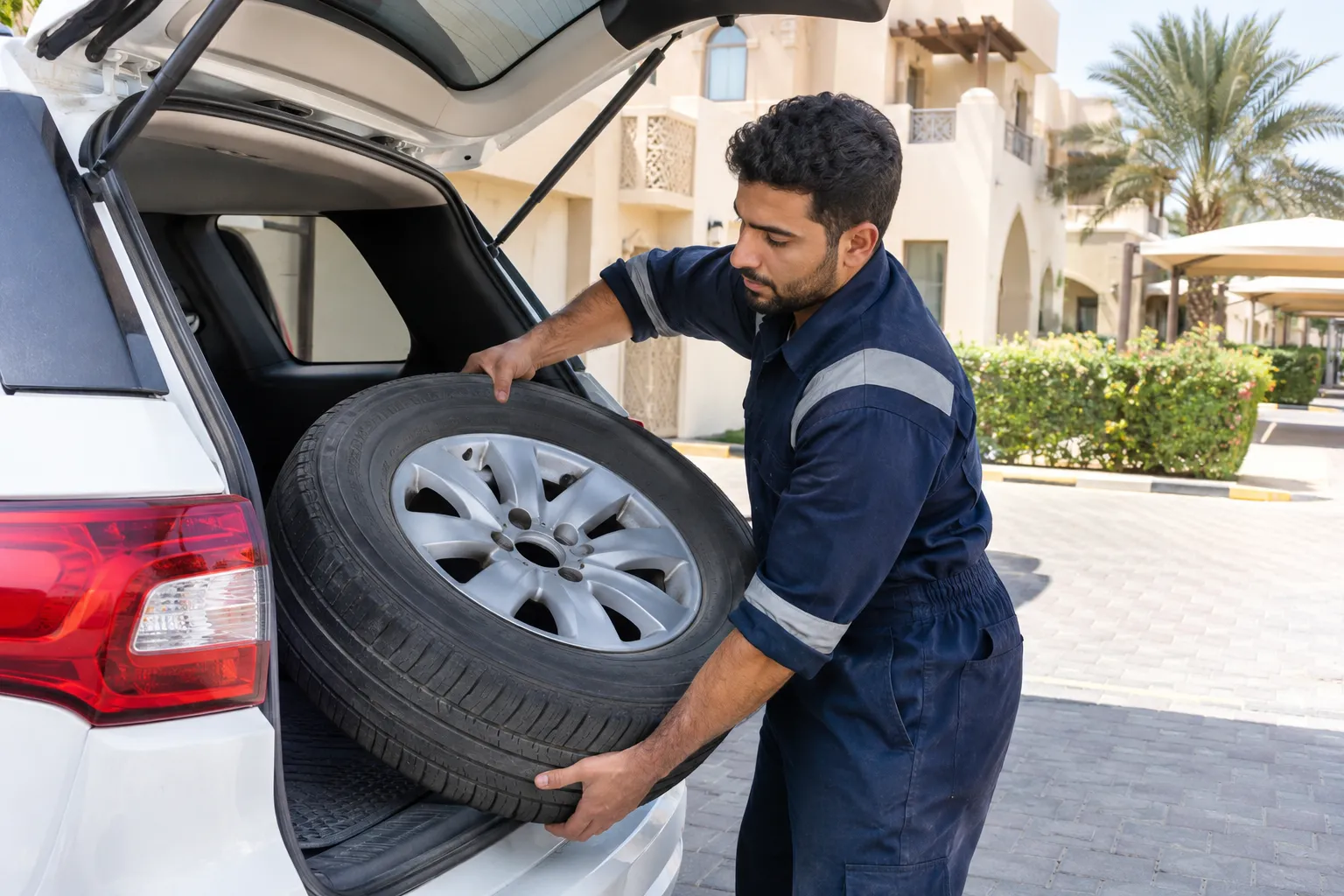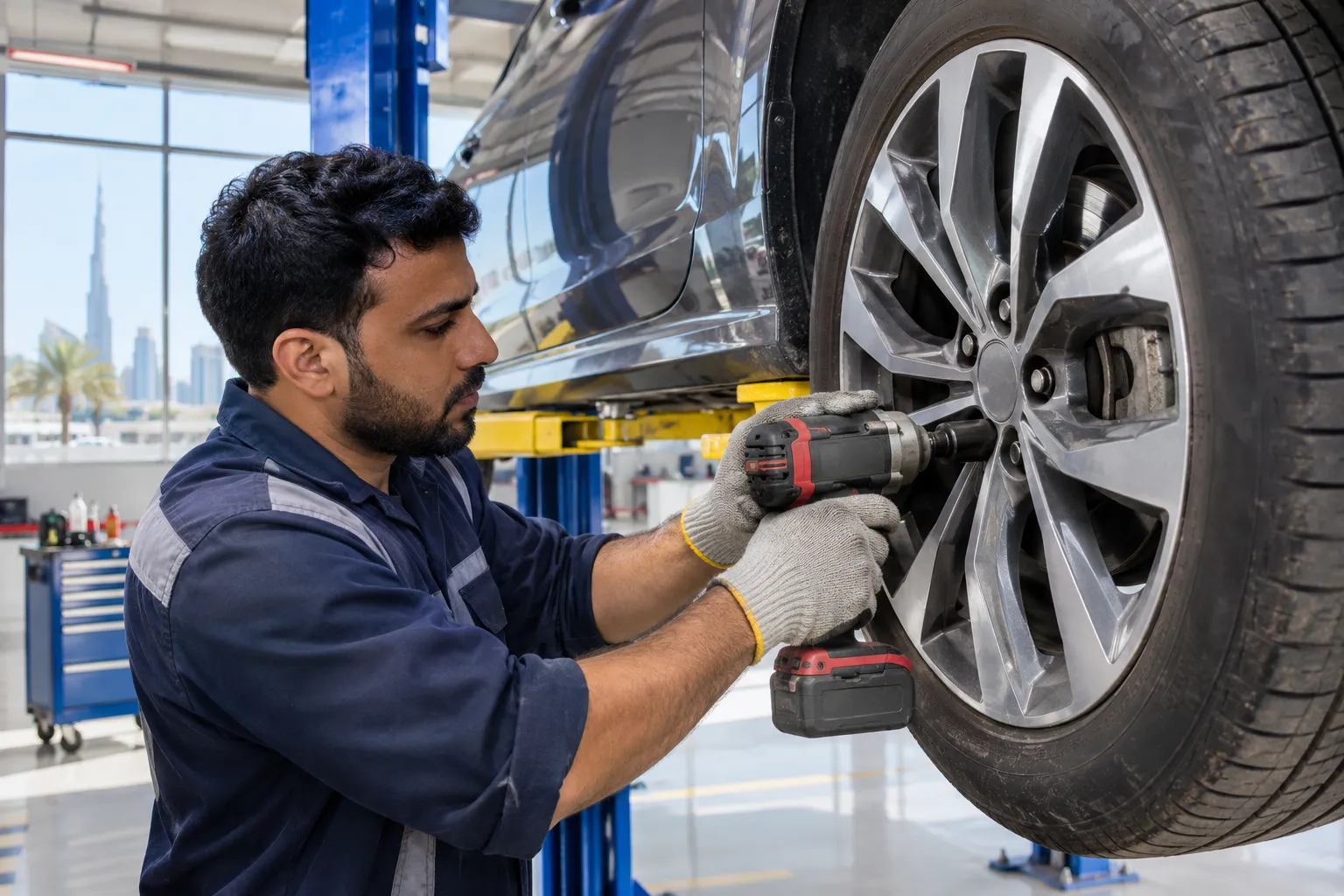
If your tyres are simply worn out and you want new ones, that is tyre replacement, and the page on that service covers choosing the right tyre. This page is about the change itself: getting the right wheel onto the hub, tightened correctly, at the right pressure, without scratching the rims or damaging the studs.
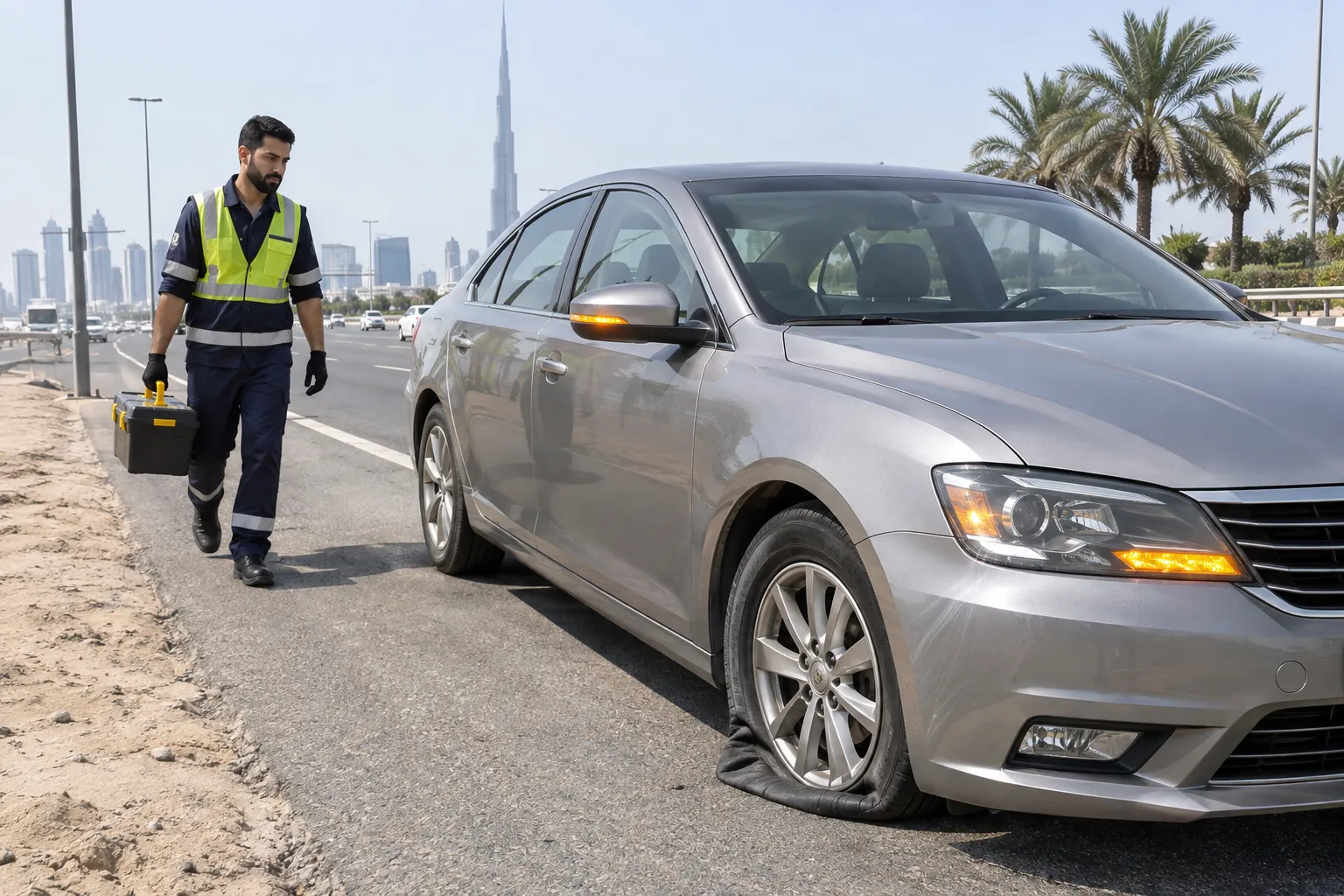
We do tyre changes at our Al Quoz workshop and from vans that come to your villa, building basement or office car park across Dubai, Sharjah and Abu Dhabi. For a broken-down car with a flat, see our roadside flat tyre help instead, which is set up for emergencies at any hour.
When you need tyre change
- You have a second set of wheels for off-road or track use and want them swapped
- You bought tyres online and need them mounted and balanced on your rims
- A damaged tyre needs to come off and the spare needs to go on
- You are moving tyres onto a new set of alloy wheels
- Your wheel nuts were overtightened by an impact gun and you cannot get them off
How we do it
- 01
Confirm the job
We check whether it is a wheel swap, a tyre mount on your rims, or a spare fitting, and ask for your locking wheel nut key if the car has one.
- 02
Lift safely
The car is raised on the manufacturer's jacking points with a trolley jack, never on the sill or floor pan, and supported before any wheel comes off.
- 03
Swap or mount
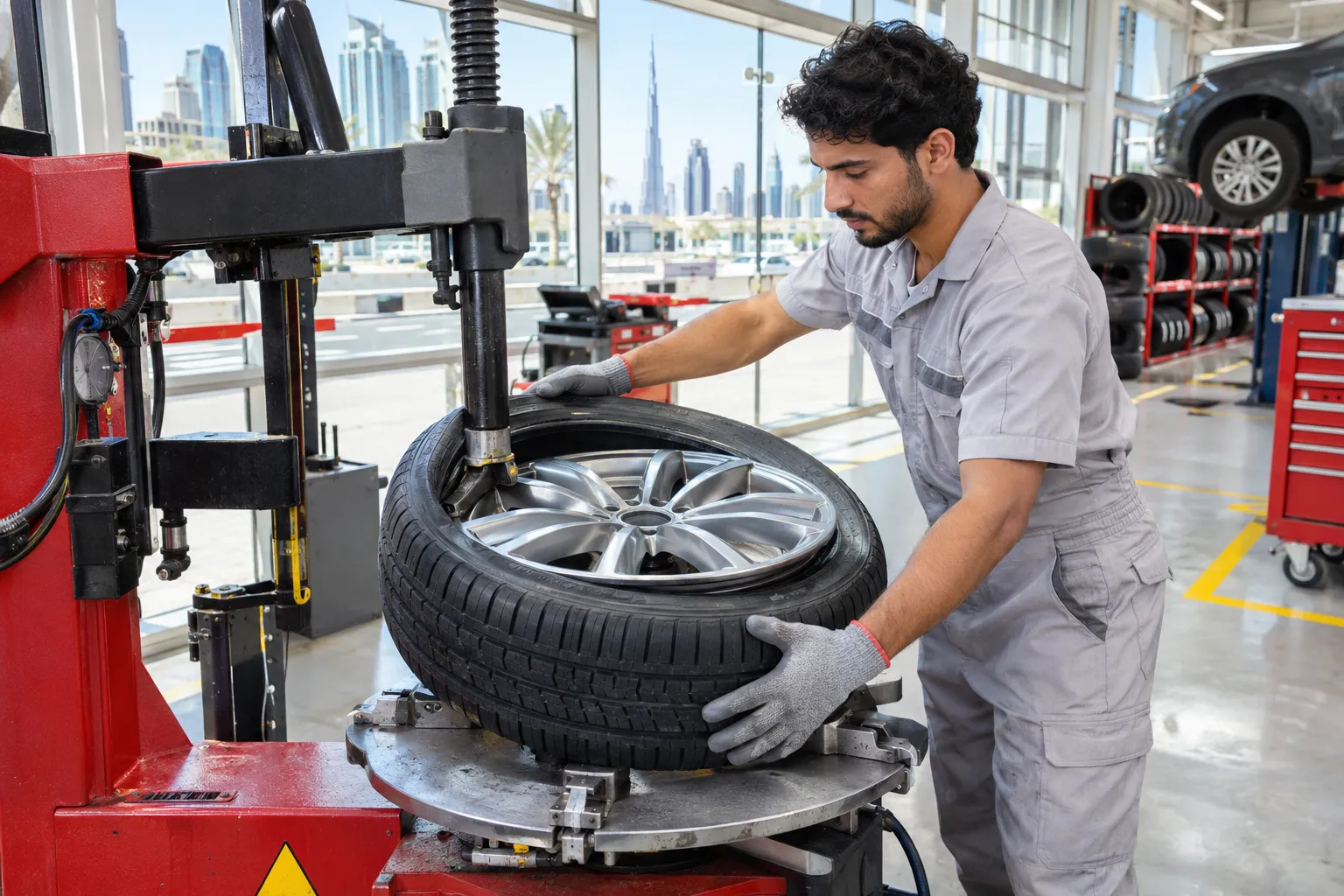
For a wheel swap, the hub face is cleaned of rust and sand. For a tyre mount, the old tyre is removed with a rim-protecting machine head and the new one fitted with a fresh valve.
- 04
Balance if needed
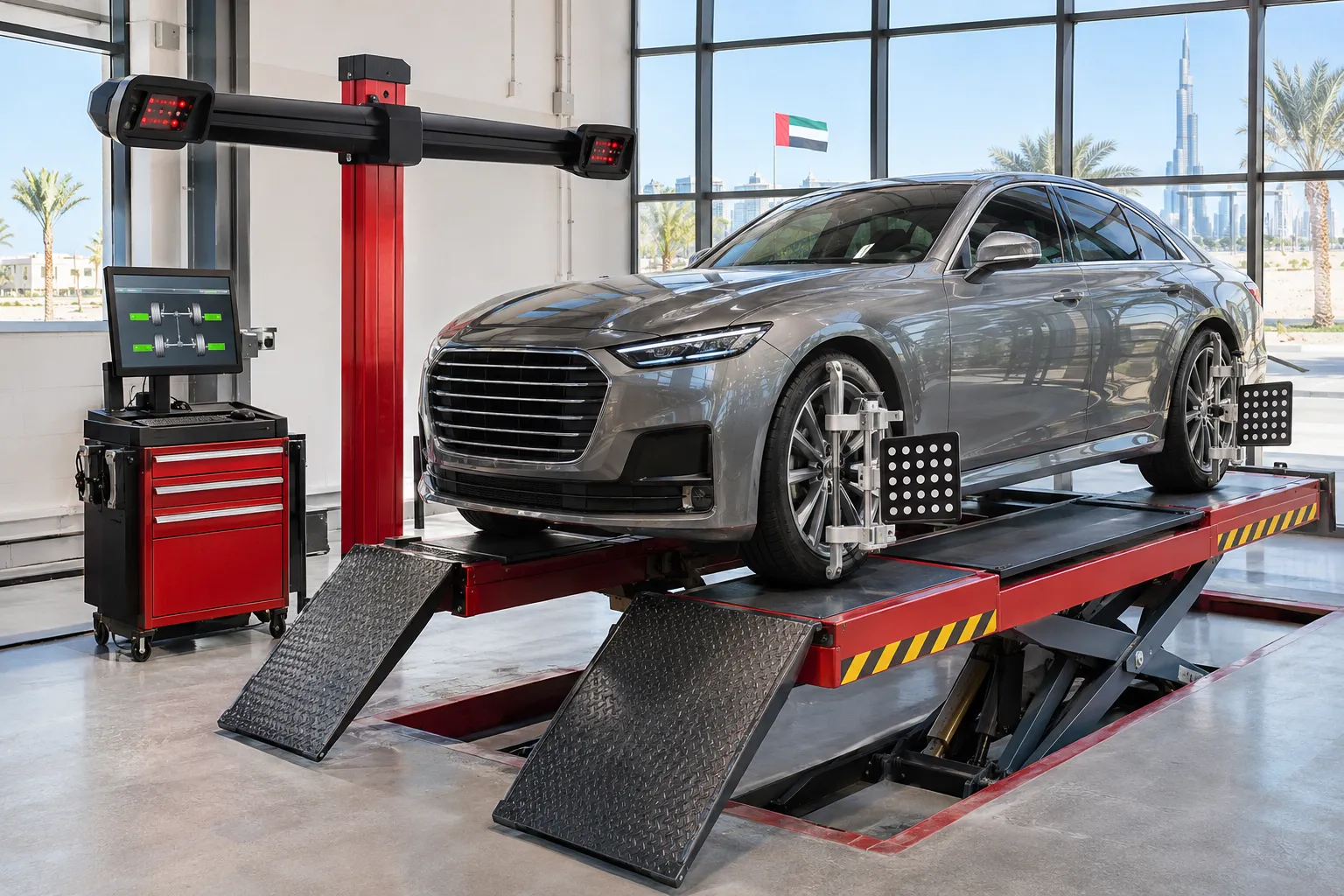
Any tyre newly mounted on a rim is balanced. Complete wheels that were balanced before and are just being swapped do not need it unless you report vibration.
- 05
Torque and set pressures
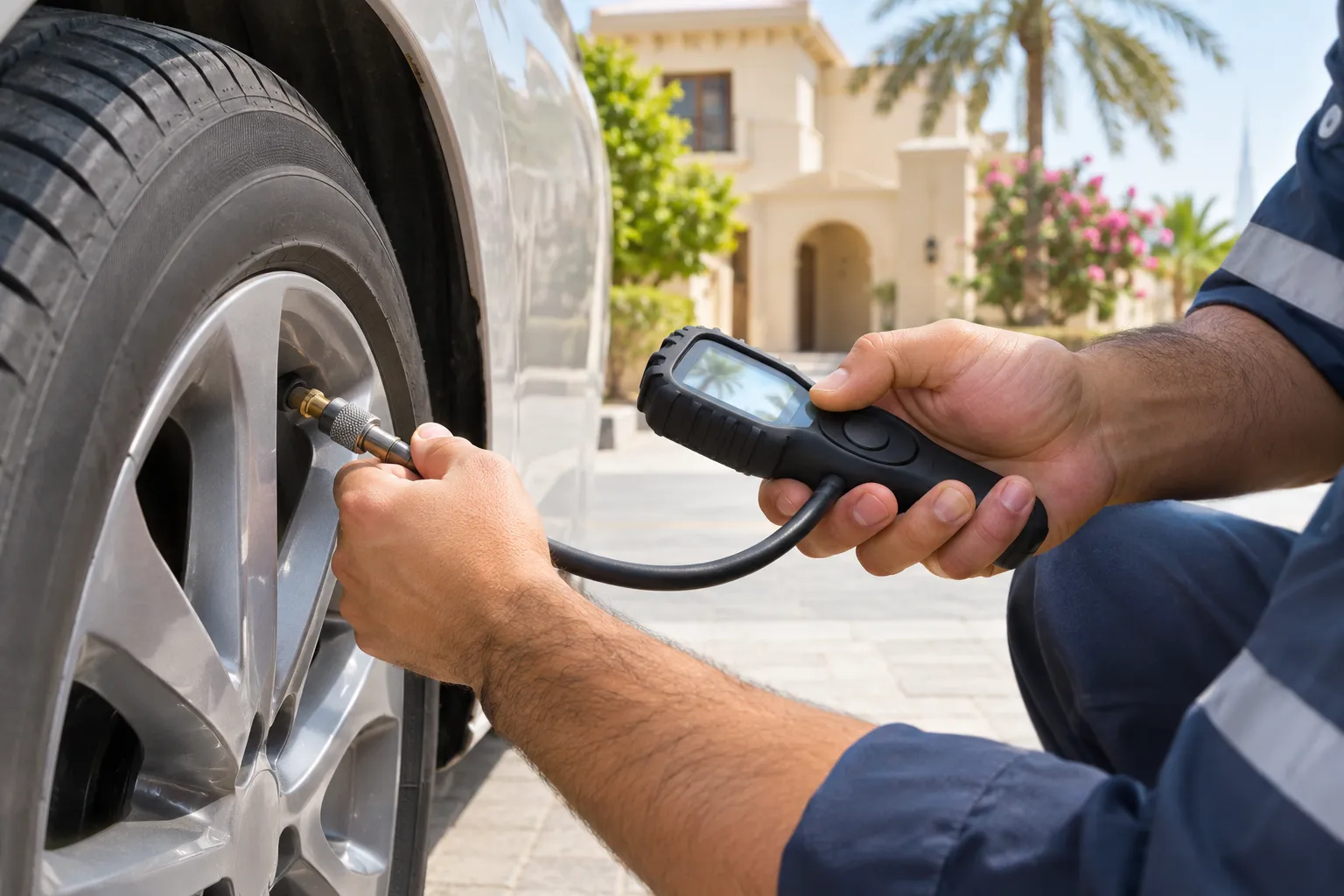
Nuts are run in by hand, then torqued in a star pattern. Pressures are set to the door placard, and we recheck the torque on alloy wheels before leaving.
Changing a wheel versus changing a tyre
A wheel change moves the complete assembly, rim and tyre together. Nothing is unmounted, so there is no balancing and the job is quick. This is what happens when we fit your spare, or when you keep a second set of rims with all-terrain tyres for the dunes and swap them over before a trip.
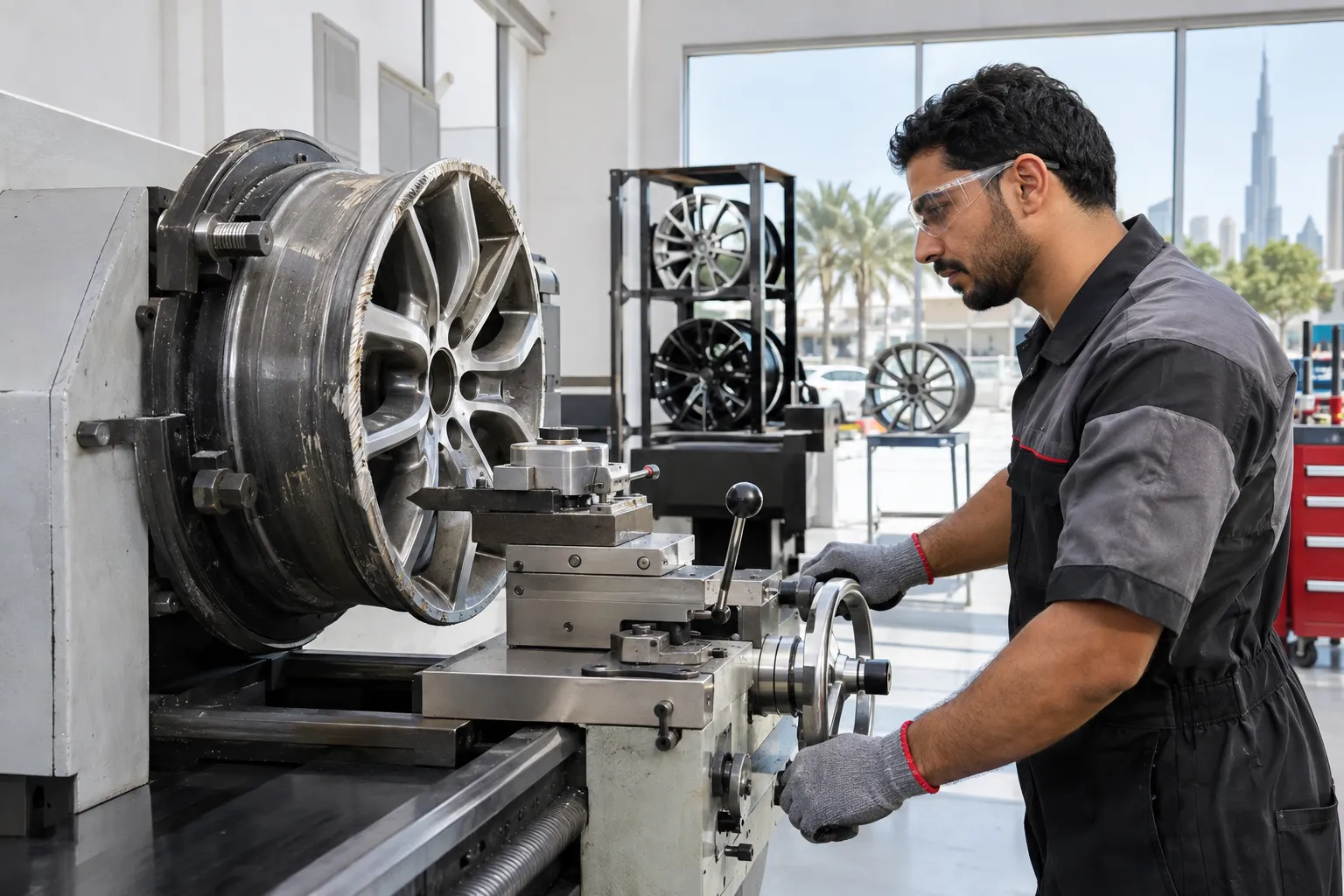
A tyre change in the strict sense takes the rubber off the rim and puts different rubber on. That needs a tyre machine, a new valve and balancing afterwards. It is the job for tyres you bought elsewhere, or when moving a set of good tyres to new alloy wheels. Low-profile and run-flat tyres need a machine with a leverless or assist-arm head, otherwise the bead can tear or the rim face gets marked.
Second sets of wheels in the UAE
Seasonal winter and summer sets are rare here, but second sets are common among 4x4 owners. A Wrangler, Land Cruiser or Patrol might run highway tyres for the week and a set of BFGoodrich or Nitto all-terrains for the desert. Swapping complete wheels is cheaper and kinder to the tyres than remounting them every time.
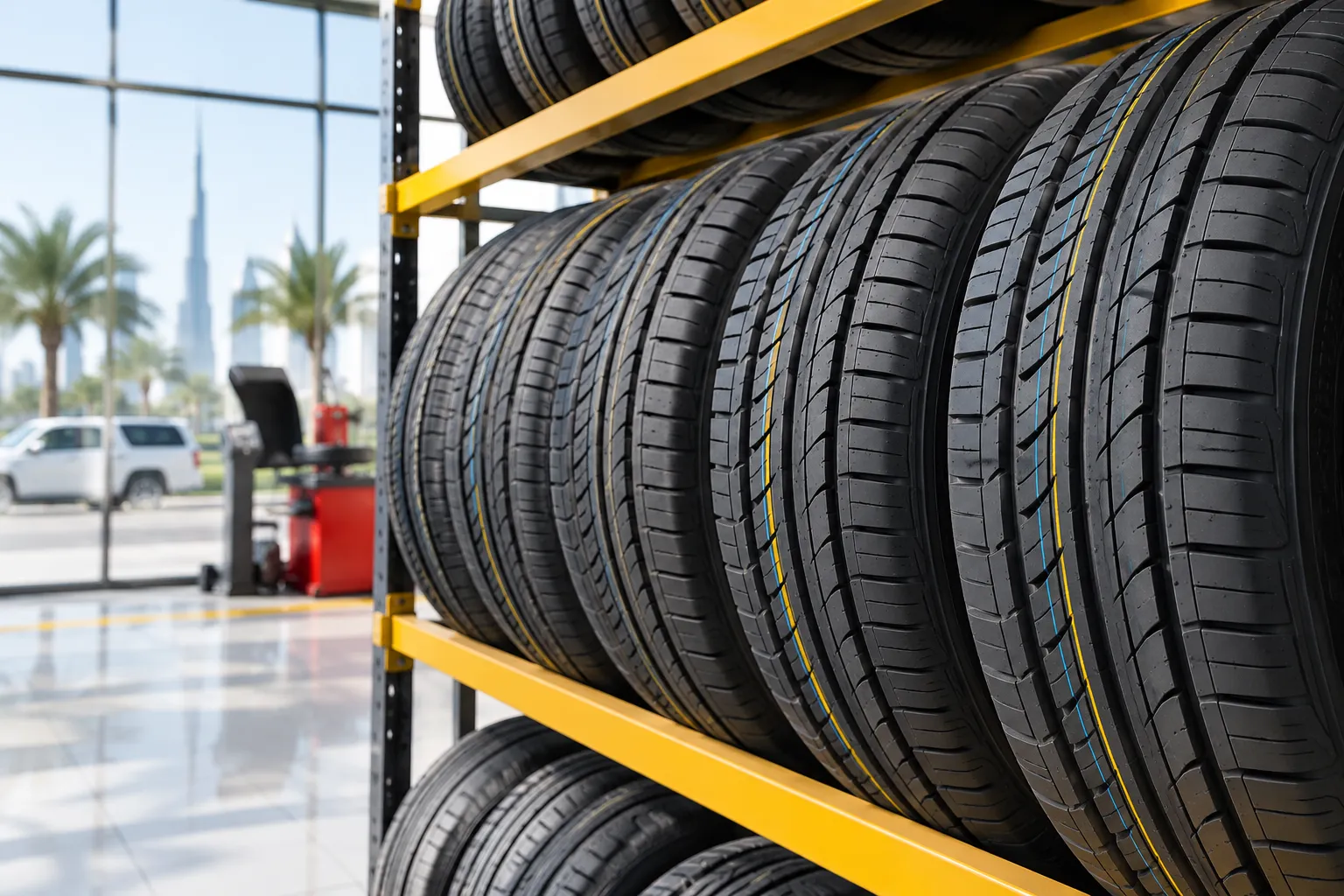
Store the off-duty set out of direct sun, stacked flat or hung, ideally in a covered garage rather than a balcony, because UV and heat crack rubber even when the tyres are not in use. Before every swap we check the pressures, which drop over months in storage, and look at the DOT age. Our page on tyres for desert driving covers deflation pressures for sand.
Wheel nut torque matters more than people think
Most of the stuck wheels we free up were tightened with an impact gun at full power. That stretches studs, warps brake discs on some cars and makes it almost impossible to change a flat at the roadside with the car's own wrench. Undertightening is worse: alloy wheels can work loose within a few hundred kilometres.
We torque by hand with a calibrated wrench to the figure for your car, typically between 100 and 140 Nm for passenger cars and higher for large SUVs and pickups. If you change a wheel yourself following our step-by-step tyre changing guide, have the torque checked within the next 50 km.
Tyre Change prices
| Service | Price |
|---|---|
| Wheel swap (complete wheels), set of fourNo mounting or balancing needed | From AED 60 |
| Mount and balance your tyres, up to 16-inch | AED 30–45 per tyre |
| Mount and balance, 17-inch+ or run-flat | AED 50–80 per tyre |
| Mobile call-out for spare fitting | AED 99–149 |
Prices in AED, including VAT. Final price confirmed before work starts.
Tyre Change: questions we get asked
How much is a tyre change in Dubai?
Swapping complete wheels starts from about AED 60 for a set of four. Mounting and balancing tyres on rims costs AED 30–45 per tyre up to 16-inch and AED 50–80 for larger sizes and run-flats. A mobile call-out to fit a spare is AED 99–149.
Can you change my tyres at home?
Yes. Our vans carry a tyre machine, balancer and compressor, so we can mount tyres and swap wheels at your villa or in most building basements. See the mobile tyre service in Dubai page for coverage.
How long does a tyre change take?
A wheel swap takes 15–30 minutes. Mounting and balancing four tyres takes 45–60 minutes. Add time for seized nuts or locking nuts without a key.
Will you fit tyres I bought online?
Yes, at our standard fitting price. Bring or deliver them to the workshop, or have them ready at home for a mobile appointment. We check the DOT date and condition before mounting.
I lost my locking wheel nut key. Can you still change the wheel?
Usually yes, using a removal socket designed for locking nuts. It takes longer and the locking nut is destroyed, so we fit a standard nut in its place.
Do I need balancing after a wheel swap?
No, if the wheels were balanced when the tyres were fitted and nothing has changed. Balancing is needed whenever a tyre is removed from or remounted on a rim.