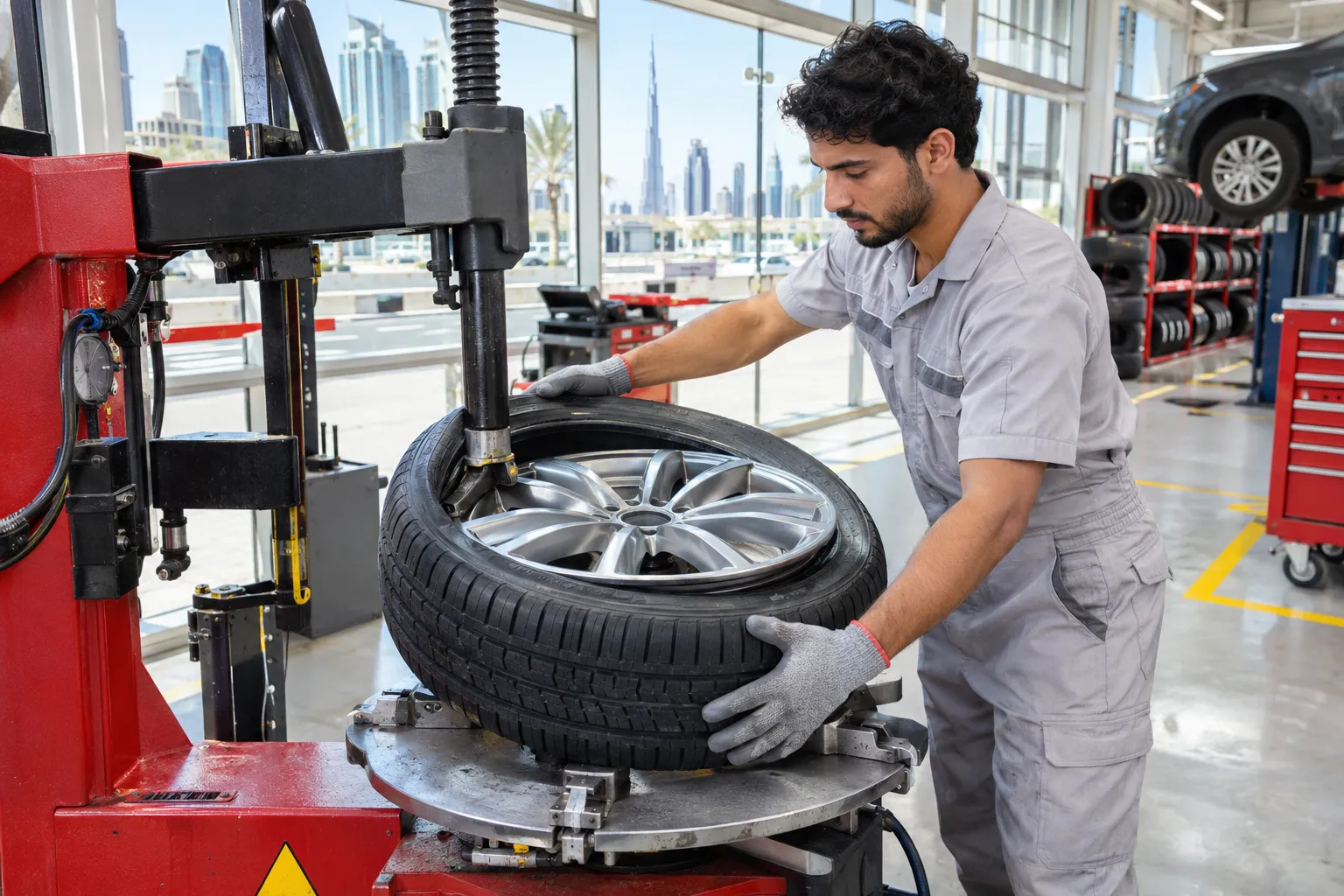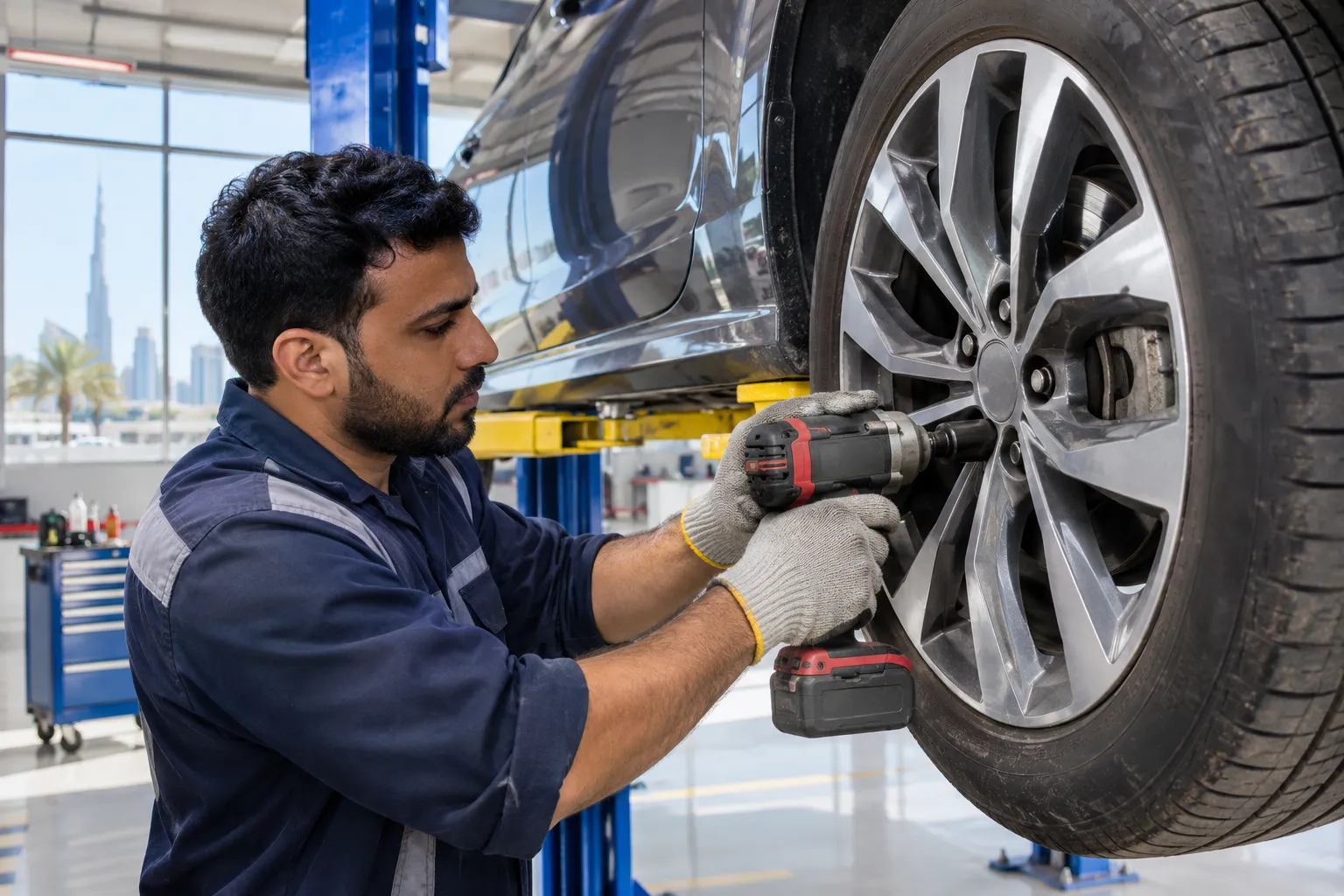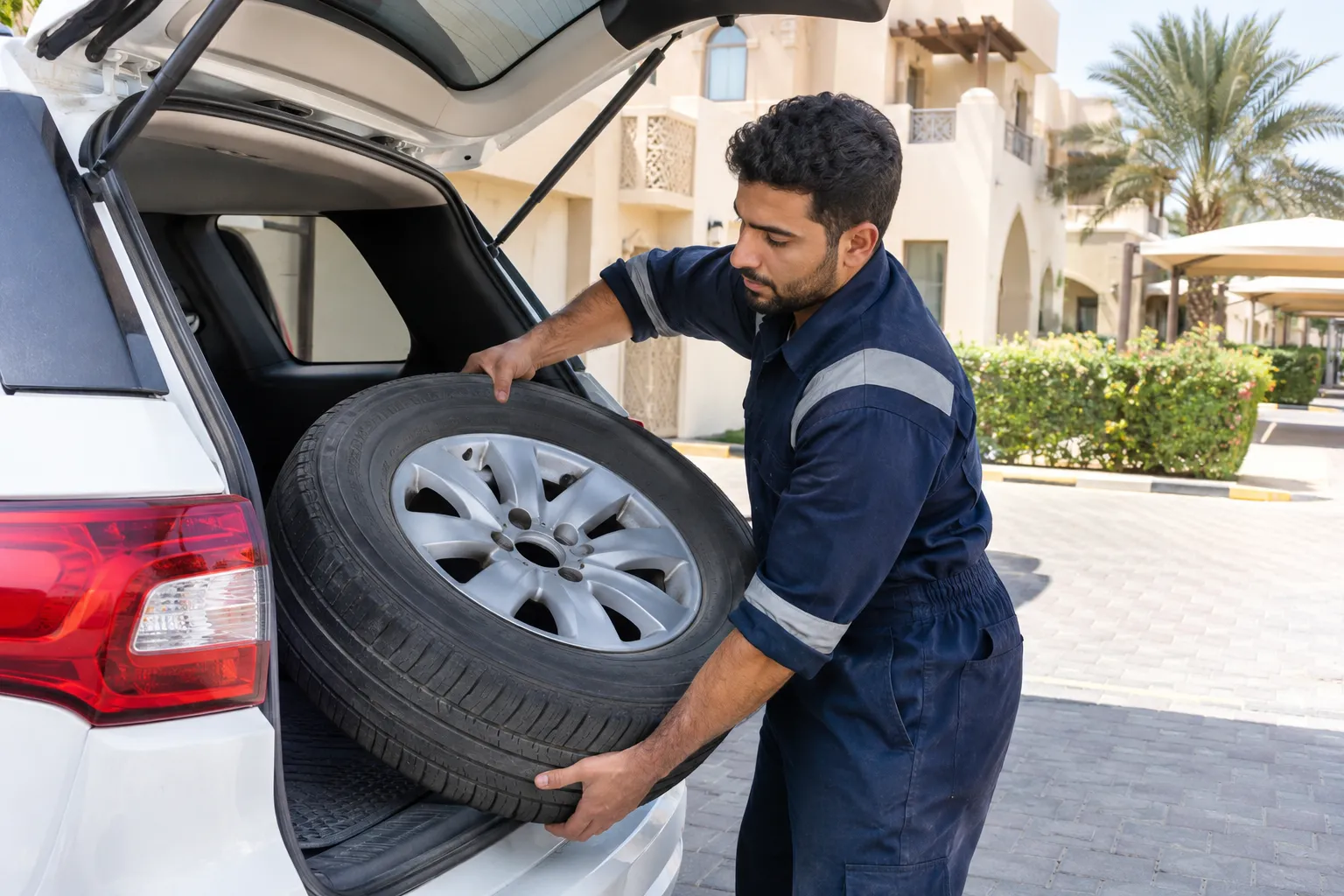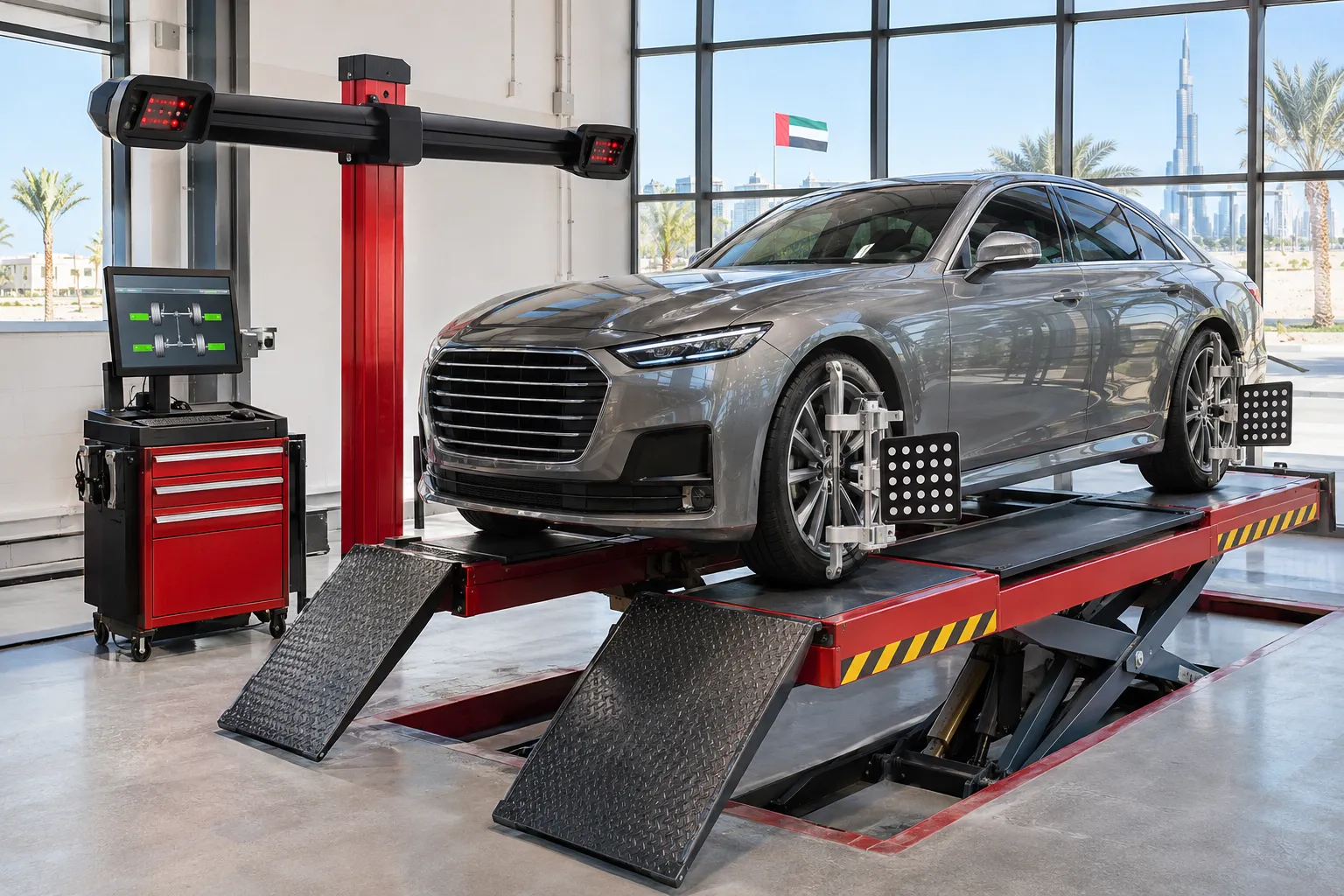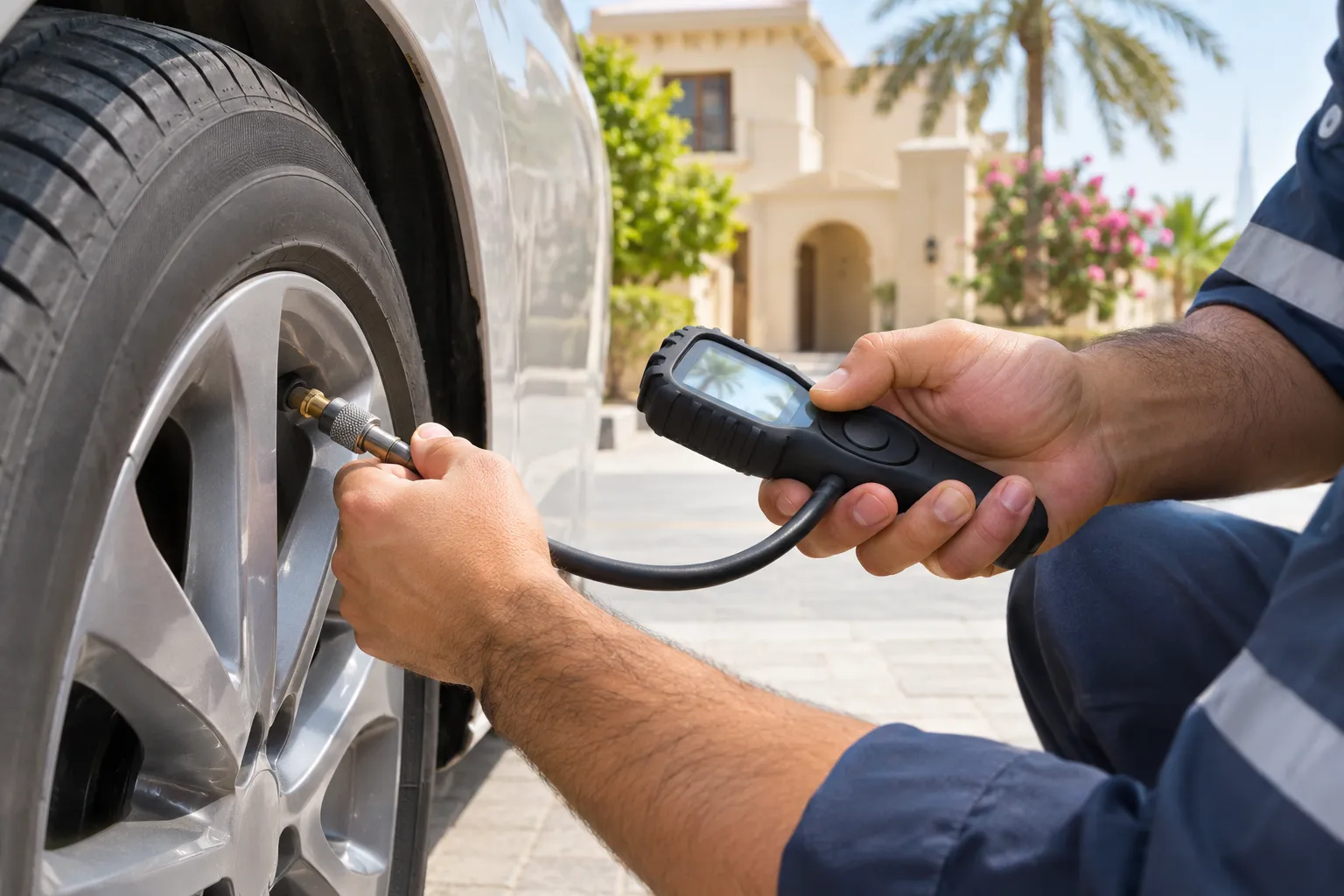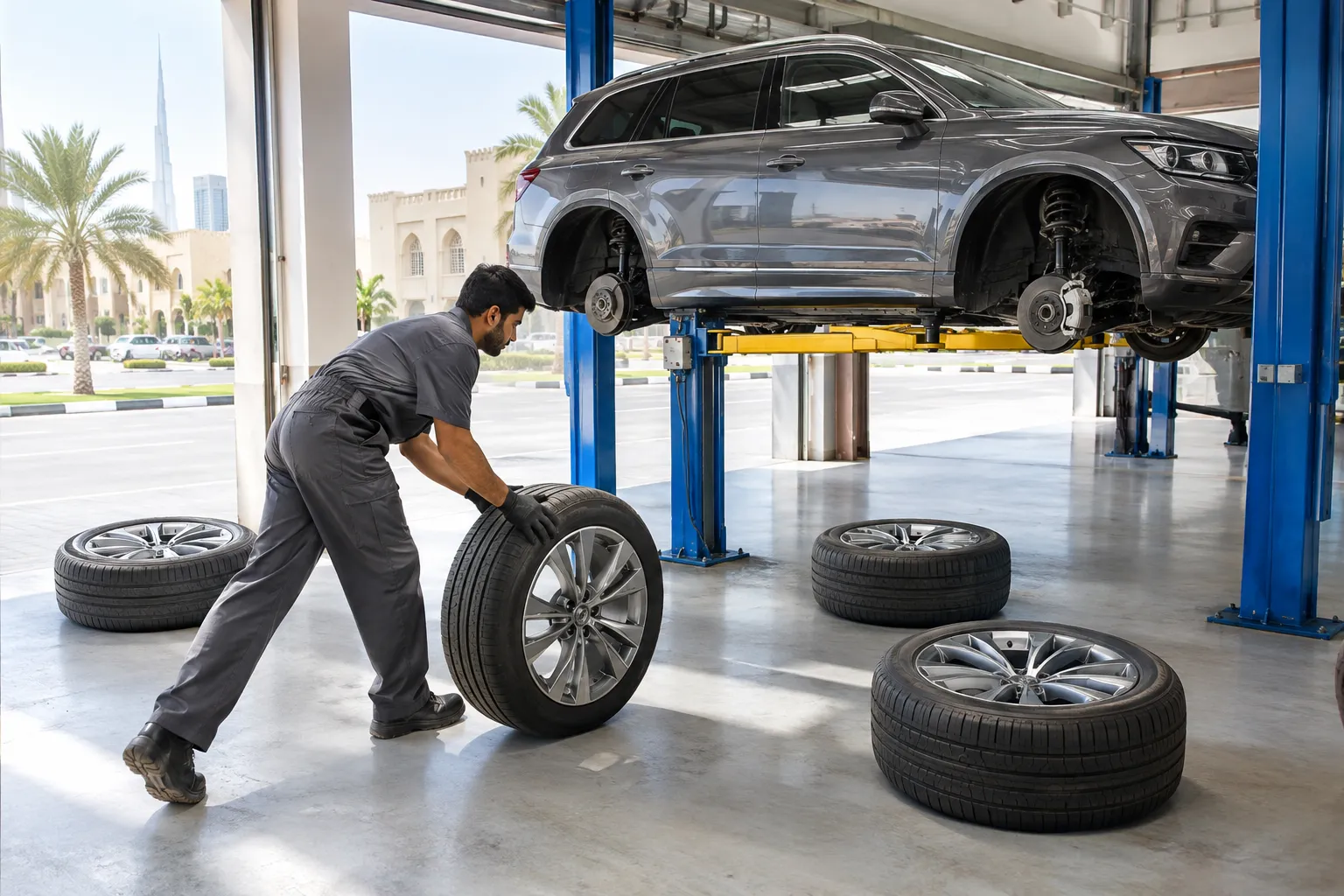
Rotation moves the tyres around the car at regular intervals so all four wear at a similar rate. Done every 8,000–10,000 km, it extends the life of the set and means you replace all four together, which keeps handling balanced. On all-wheel-drive cars, it also keeps tread depths close, which protects the drivetrain.
A rotation at our Al Quoz workshop costs AED 60–80 and includes a tread depth check at every position, pressure setting and a visual inspection. It pairs well with wheel balancing, since the wheels are off anyway.
When you need tyre rotation
- It has been 8,000–10,000 km since the last rotation
- The front tyres have visibly less tread than the rears, or the other way round
- You are at a routine oil service and the wheels are coming off anyway
- You drive an AWD vehicle and want to keep tread depths even
- You have a full-size spare that has never been used in rotation
How we do it
- 01
Measure first
We measure tread depth on each tyre at the inner, centre and outer grooves and note any uneven wear.
- 02
Choose the pattern
The pattern depends on drivetrain, whether tyres are directional, and whether front and rear sizes differ.
- 03
Move the wheels
Wheels are moved to new positions, hub faces cleaned, nuts torqued in a star pattern.
- 04
Set pressures
Pressures are set to the placard for each axle, since front and rear figures often differ.
- 05
Update TPMS
Cars with position-specific TPMS displays are relearned so each reading appears on the correct wheel.
Rotation patterns explained
For most front-wheel-drive cars with non-directional tyres, the forward cross is standard: front tyres move straight back, and rear tyres cross to the opposite side at the front. Rear-wheel-drive and many four-wheel-drive vehicles use the rearward cross: rears move straight forward and fronts cross to the opposite side at the rear.
Directional tyres, marked with an arrow on the sidewall, can only roll one way, so they move straight front to back on the same side. If a full-size spare is in good condition and the same size, it can be included in a five-tyre rotation, which is common with 4x4s carrying a matching spare.
- FWD, non-directional: forward cross
- RWD and 4x4, non-directional: rearward cross
- Directional tyres: front to back on the same side
- Staggered sizes: side to side only, if tyres are non-directional
When rotation is not possible
Many performance cars and some SUVs run staggered setups, with wider tyres at the rear than at the front. Those cannot move between axles. If the tyres are non-directional, they can be swapped side to side, but that usually means remounting on the rims, which costs more. On staggered cars, the best way to control wear is regular wheel alignment and correct pressures.
Rotation also will not fix wear caused by a problem. If a tyre has worn on one edge from bad alignment or a worn suspension part, moving it to another position just spreads the problem. Fix the cause first.
Why AWD owners should take rotation seriously
All-wheel-drive systems on cars like the Subaru Outback, Audi quattro models and many modern SUVs are sensitive to differences in tyre diameter. A worn tyre has a smaller rolling diameter than a new one, so it turns slightly faster. If the difference between axles grows too large, the centre coupling or differential works constantly, heats up and wears out. Regular rotation keeps tread depths within a narrow range and avoids that.
Read our article on how long tyres last in the UAE for realistic mileage figures, and the tyre performance guide for what affects wear.
Tyre Rotation prices
| Service | Price |
|---|---|
| Tyre rotation, four wheels | AED 60–80 |
| Rotation with balancing | AED 60–80 + AED 25 per wheel |
| Rotation + alignment | From AED 180 |
Prices in AED, including VAT. Final price confirmed before work starts.
Tyre Rotation: questions we get asked
How often should tyres be rotated?
Every 8,000–10,000 km, or at every other oil change. Check your owner's manual, as some manufacturers give their own interval.
How much is tyre rotation in Dubai?
AED 60–80 for four wheels at our Al Quoz workshop, including pressure setting and a tread depth check.
Is tyre rotation really necessary?
It is not required by law, but it extends the life of a set and keeps handling balanced. On AWD cars it also protects the drivetrain.
Can directional tyres be rotated?
Yes, but only front to back on the same side of the car, so they keep rolling in the direction of the arrow.
Should I do tyre rotation and alignment together?
It is a sensible combination. Rotation evens out wear, alignment stops uneven wear from happening in the first place.
Do I need balancing when rotating tyres?
Not always. If you feel vibration after rotation, a wheel that was on the rear may be slightly out of balance; balancing fixes it.