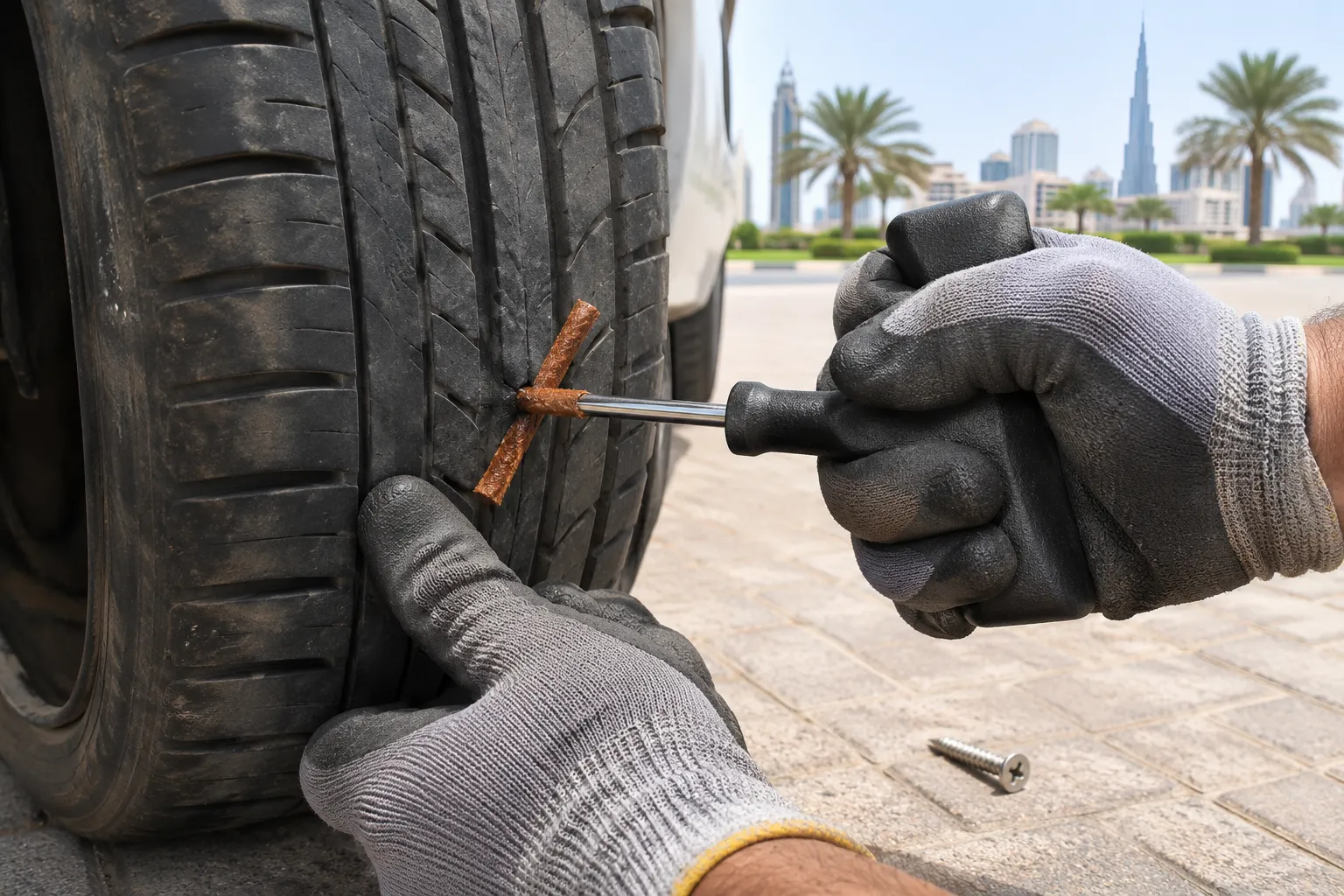
Not every puncture can be repaired, and a good repairer will say so. Damage in the shoulder or sidewall, holes larger than 6 mm, and tyres damaged by driving flat must be replaced. We explain the reason each time rather than just quoting for a new tyre. If you want the background first, our article can a punctured tyre be repaired? goes through the rules with photos.
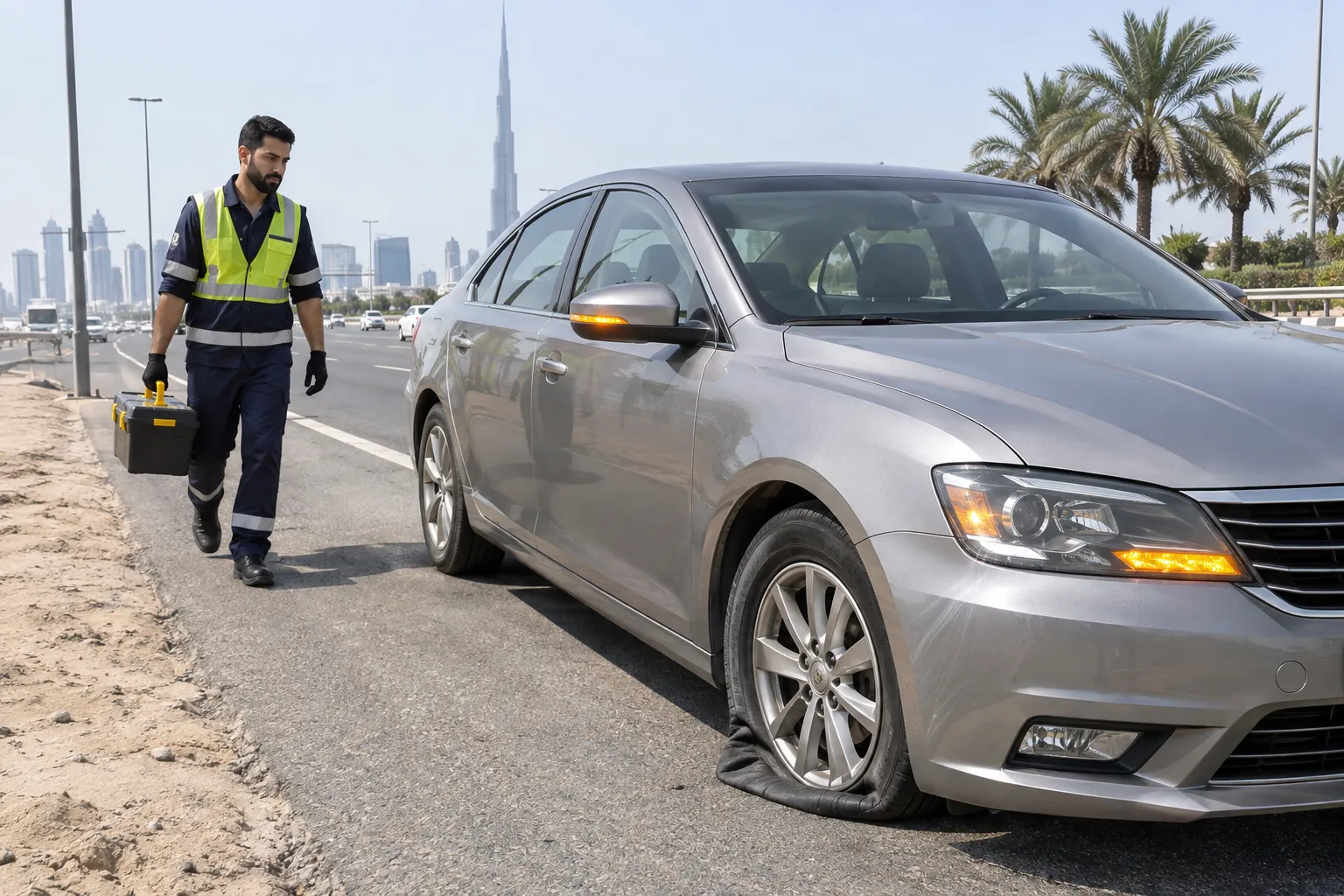
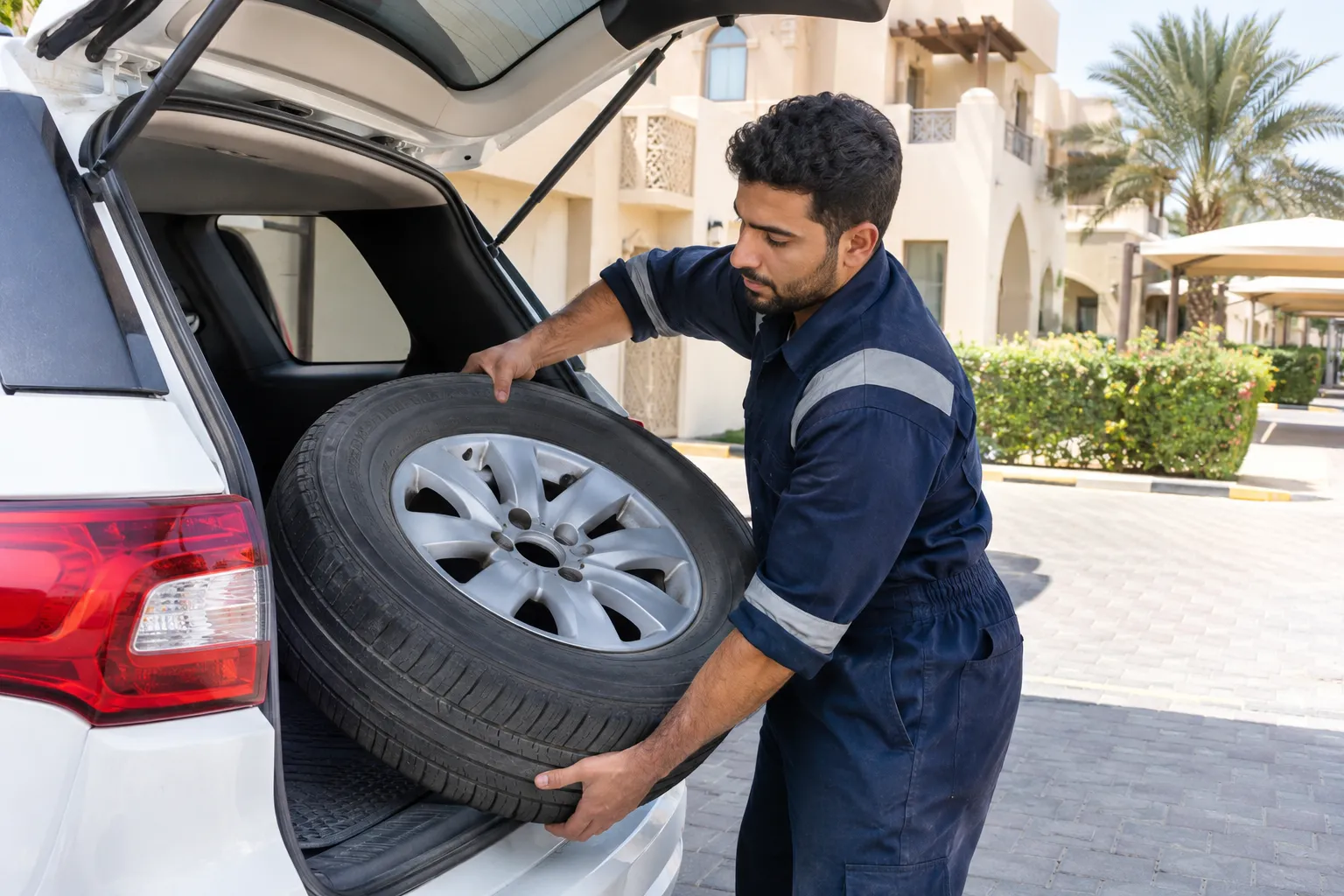
At our Al Quoz workshop a repair costs AED 35–50 per tyre. If you cannot drive the car, our vans do mobile puncture repair for AED 99–149 including the call-out. Both use the same method and the same materials.
When you need puncture repair
- A nail, screw or piece of metal is stuck in the tread
- One tyre loses a few psi every day or two
- The TPMS warning comes on repeatedly for the same wheel
- You hear a faint hiss near the tyre when the car is parked
- A previous plug has started leaking or is visibly lifting
How we do it
- 01
Locate the injury
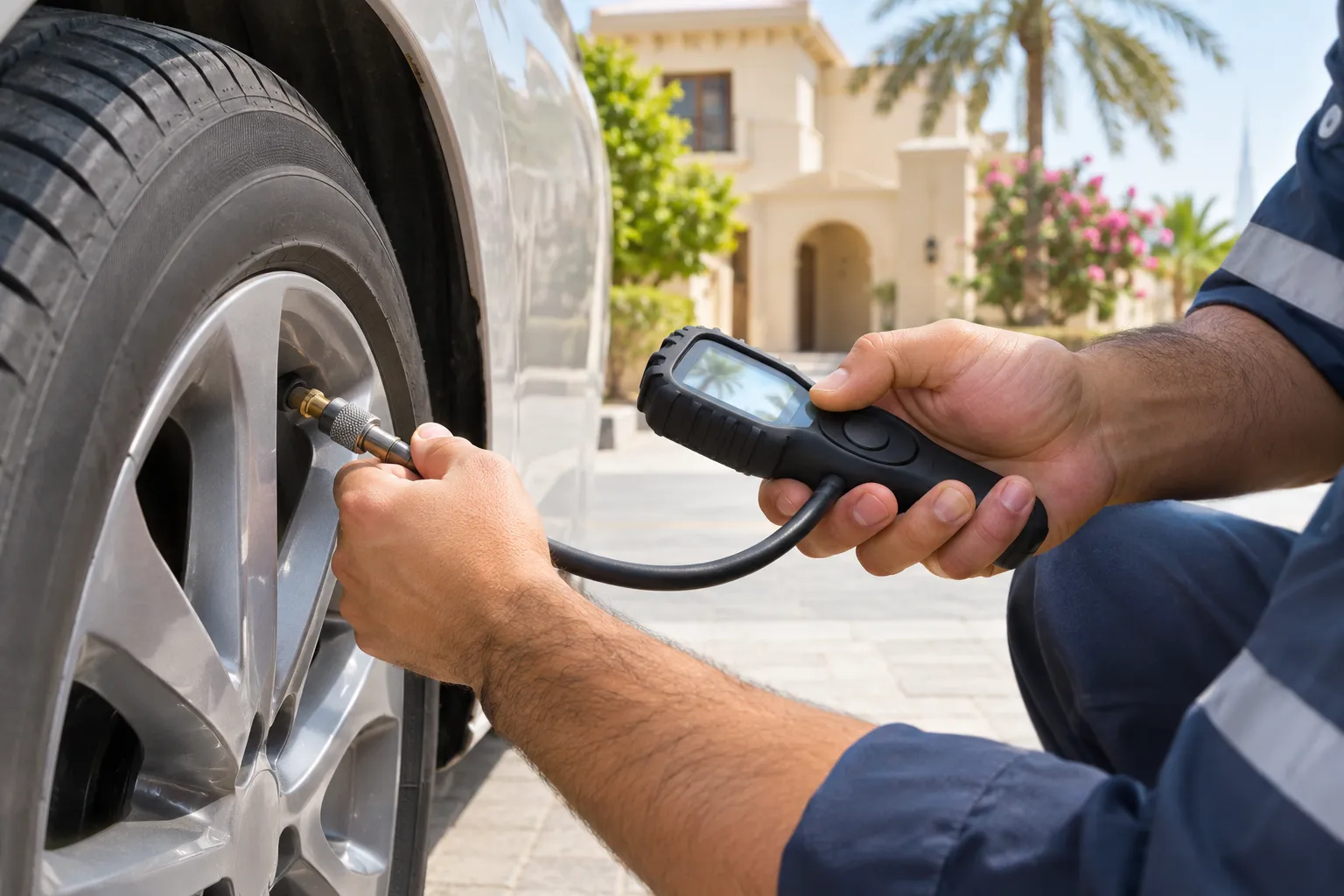
We inflate the tyre and use soapy water to find the exact leak point, marking it before removing any object.
- 02
Demount and inspect inside
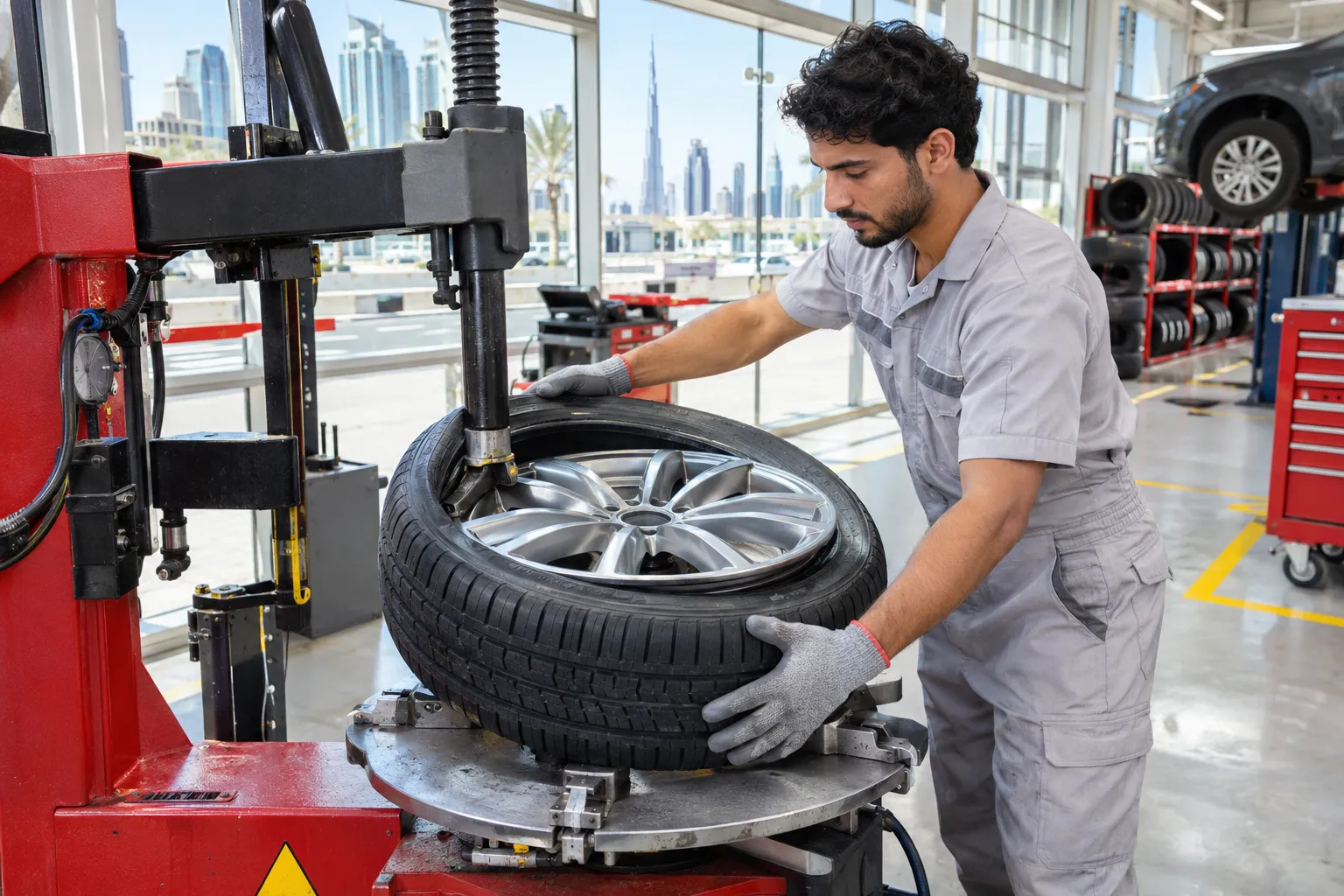
The tyre comes off the rim so we can check the inner liner for rubbing marks, cords showing, or a second hole. This step is skipped by quick roadside plugs and it is the one that matters.
- 03
Check the zone and size
The injury must be inside the central three-quarters of the tread width and no wider than 6 mm, and must not overlap an earlier repair.
- 04
Prepare and fill
The channel is cleaned with a carbide tool, the liner around it is buffed and treated with vulcanising cement, and a plug-patch is pulled through from inside.
- 05
Seal, refit and balance
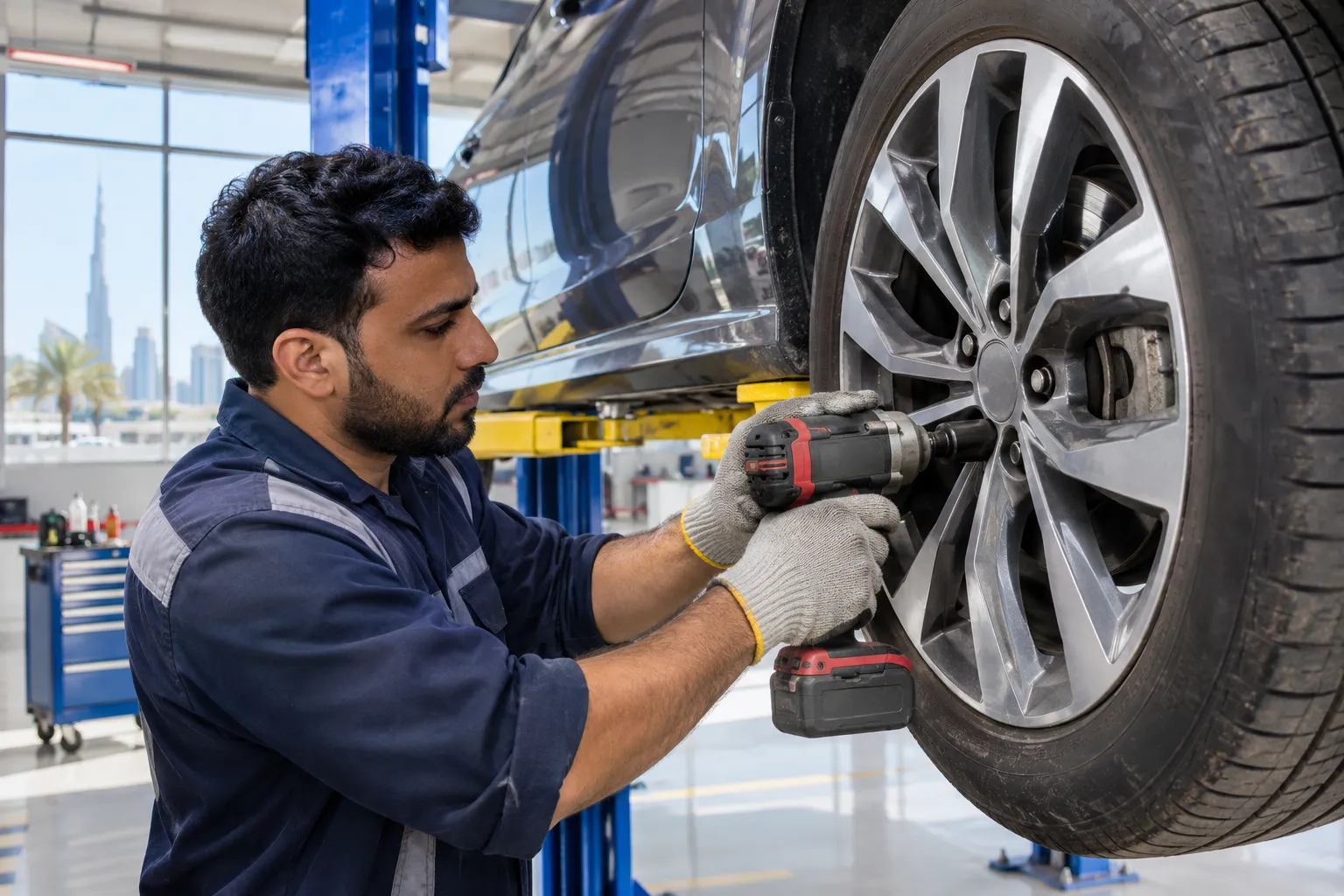
The patch is rolled down, excess plug trimmed, and the tyre remounted, leak-tested and balanced, since the repair adds a few grams.
The repairable zone: where a puncture can be fixed
Car tyre repair standards limit repairs to the central part of the tread, roughly the middle three-quarters of the tread width. Imagine the tread divided into eight equal strips across its width: the outer strip on each side is off limits. The reason is flex. The shoulder and sidewall bend with every rotation, and a repair there works loose or fatigues the cords around it.
The size limit for car tyres is 6 mm across the injury after it has been cleaned out. A typical nail or screw is 3–5 mm, so most nails are fine; a bolt, a piece of rebar or a tear is usually not. Two repairs should not overlap, and we generally refuse a third repair on the same tyre.
- Inside the central three-quarters of the tread: repairable
- In the shoulder or outer edges of the tread: not repairable
- Anywhere on the sidewall: not repairable
- Larger than 6 mm, or a cut rather than a hole: not repairable
Plug, patch, or plug-patch?
A string plug is a strip of sticky rubberised cord pushed into the hole from outside without removing the tyre. It is quick and useful to get home, but nobody looks inside the tyre, the hole is not sealed at the liner, and over time moisture can travel along the injury into the steel belts. Treat it as temporary.
A patch alone is applied inside the tyre and seals the liner, but leaves the channel through the tread open to water and grit. The plug-patch, a single piece with a stem and a patch head, does both jobs: the stem fills the channel and the head seals the inner liner. It is the method we use by default. There is a longer comparison in our article on tyre plug vs patch.
Why we refuse sidewall repairs
The sidewall carries the load and flexes constantly. Its cords run radially and there is no steel belt underneath to support a repair. A plug or patch there cannot hold the cords together; at speed and in summer heat it can fail suddenly. No reputable tyre maker approves sidewall repairs on car tyres, and if a shop offers one, that is a reason to go elsewhere.
The same applies to a tyre with a bulge or bubble, which means the internal cords have already broken, usually from a pothole or speed bump hit. That tyre needs replacing, even if it is holding air. Our guide to sidewall bulges explains how they form.
Run-flats, sealant and TPMS
Run-flat tyres can be repaired when the puncture is in the repair zone and the tyre was not driven far on zero pressure, but some car and tyre makers advise against repairing them at all. We inspect the inside for heat damage and follow the manufacturer's guidance. If you have used a sealant kit, we clean the liner and check the TPMS sensor before patching, as sealant can block its port.
Puncture Repair prices
| Service | Price |
|---|---|
| Puncture repair at workshop (plug-patch)Includes rebalance | AED 35–50 per tyre |
| Mobile puncture repair, call-out included | AED 99–149 |
| Night call-out, 22:00–06:00 | + AED 50 |
| Valve replacement if needed | AED 15–25 |
Prices in AED, including VAT. Final price confirmed before work starts.
Puncture Repair: questions we get asked
How much is a tyre puncture repair in Dubai?
AED 35–50 per tyre at our Al Quoz workshop, including rebalancing. Mobile puncture repair at your location costs AED 99–149 including the call-out, plus AED 50 at night.
Is a plugged tyre safe to drive on?
An external string plug is a temporary fix to get you home. A plug-patch fitted from inside, within the repair zone, is a permanent repair and safe for normal driving.
Can a tyre be repaired near the sidewall?
No. Punctures in the shoulder, the outer edge of the tread or the sidewall cannot be repaired safely because those areas flex too much. The tyre needs replacing.
How many times can a tyre be repaired?
We generally allow up to two repairs per tyre, as long as they do not overlap and the tyre has no other damage. Beyond that, replacement is safer.
How long does a puncture repair last?
A correctly installed plug-patch lasts as long as the tyre itself. If a repair starts leaking, it was usually a plug only or the inside was not prepared properly.
Where can I find a tyre puncture shop near me?
Our workshop is at 46 28B Street, Al Quoz Industrial Area 3. If you are further away, our vans cover Dubai, Sharjah and Abu Dhabi; see tyre repair near me.