Puncture & Repair
Can a Punctured Tyre Be Repaired? A Technician's Checklist
Can your punctured tyre be repaired? Six checks a technician makes: hole location, size, driven-flat damage, previous repairs, tread depth and tyre age.
Yes, most punctured tyres can be repaired, provided the hole is in the central tread area, is no larger than 6 mm across, and the tyre hasn’t been driven while flat or badly under-inflated. Punctures in the sidewall or the shoulder, large cuts, and tyres with internal damage from running low have to be replaced.
In my first year as a technician I thought the size of the nail was the main thing. It isn’t. There are six questions I run through on every punctured tyre, and any one of them can turn a AED 40 repair into a new tyre.
Key takeaways
- The repairable zone is the central part of the tread, away from the shoulders.
- Maximum injury size for a car tyre repair is about 6 mm.
- Driving on a flat or very soft tyre often damages it beyond repair, even if the hole itself is tiny.
- Repairs must not overlap an earlier repair. We stop at two per tyre.
- A tyre below 1.6 mm tread or past its five-year age limit isn’t worth repairing.
Question 1: Where is the hole?
This is the first thing I check, before even pulling the screw out.
Central tread: usually repairable. Imagine the tread divided into four equal strips running around the tyre. Punctures in the middle two, and generally a little beyond them, are in the area a repair can be relied on. That’s because this part of the tyre is supported by the steel belts and doesn’t flex as much.
Shoulder: not repairable. The shoulder is where the tread curves down into the sidewall. It bends every revolution. A plug there works loose, and a patch can’t seal properly on the curve.
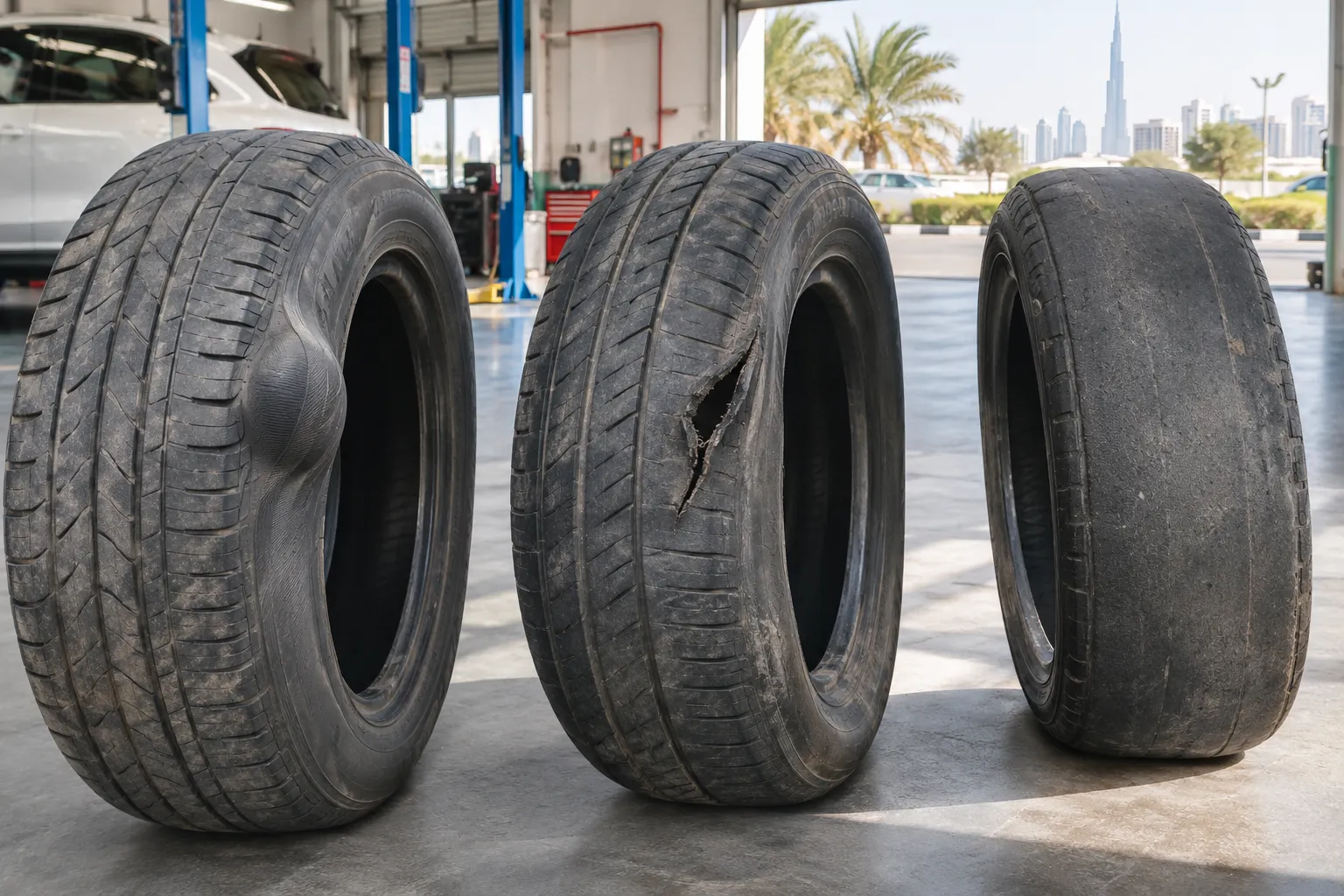
Sidewall: never repairable. The sidewall carries the car’s weight and flexes the most. Even a tiny nail hole here means replacement. Our blog on sidewall bulges covers related sidewall damage.
Question 2: How big is the injury?
For passenger car tyres, the limit is around 6 mm diameter. Most screws and nails are 3–5 mm, which is why they’re usually fine.
Things that are too big:
- Bolts and large screws from construction sites
- Pieces of metal strip, which leave a slit rather than a round hole
- Cuts from glass, kerb edges or debris
- Anything that tore the tread rather than piercing it
A slit 10 mm long is not a 6 mm hole, even if it’s narrow. The plug can’t fill it.
Question 3: Was the tyre driven while flat?
This is the question drivers don’t like, and the one that ends the most repairs.
When a tyre is driven with very low pressure, the sidewall folds over on itself and grinds against the inner liner. It can happen in a few hundred metres at speed. From the outside, the tyre may look perfect. Inside, you’ll find:
- A ring of grey or black rubber dust
- A shiny or scuffed band around the inner sidewall
- Wrinkles or creases in the liner
- In bad cases, exposed cords
Any of these means the casing is weakened. I won’t repair it, however small the hole. This is why we take tyres off the rim to repair them; a plug from outside can’t tell you any of this. More on the difference in plug vs patch repairs.
What to do: As soon as you feel the car pulling, hear flapping, or see the pressure warning, slow down and stop safely. Driving another two kilometres to the next exit is often what kills the tyre.
Question 4: Has it been repaired before?
Repairs shouldn’t overlap or sit too close together. If the new puncture lands near an old plug, there’s not enough sound material between them. We generally stop at two repairs per tyre. A third puncture in a tyre that’s already been repaired twice gets a recommendation to replace.
Also check for earlier temporary repairs. A string plug fitted at the roadside months ago and never followed up may be hiding a damaged liner.
Question 5: How much tread is left?
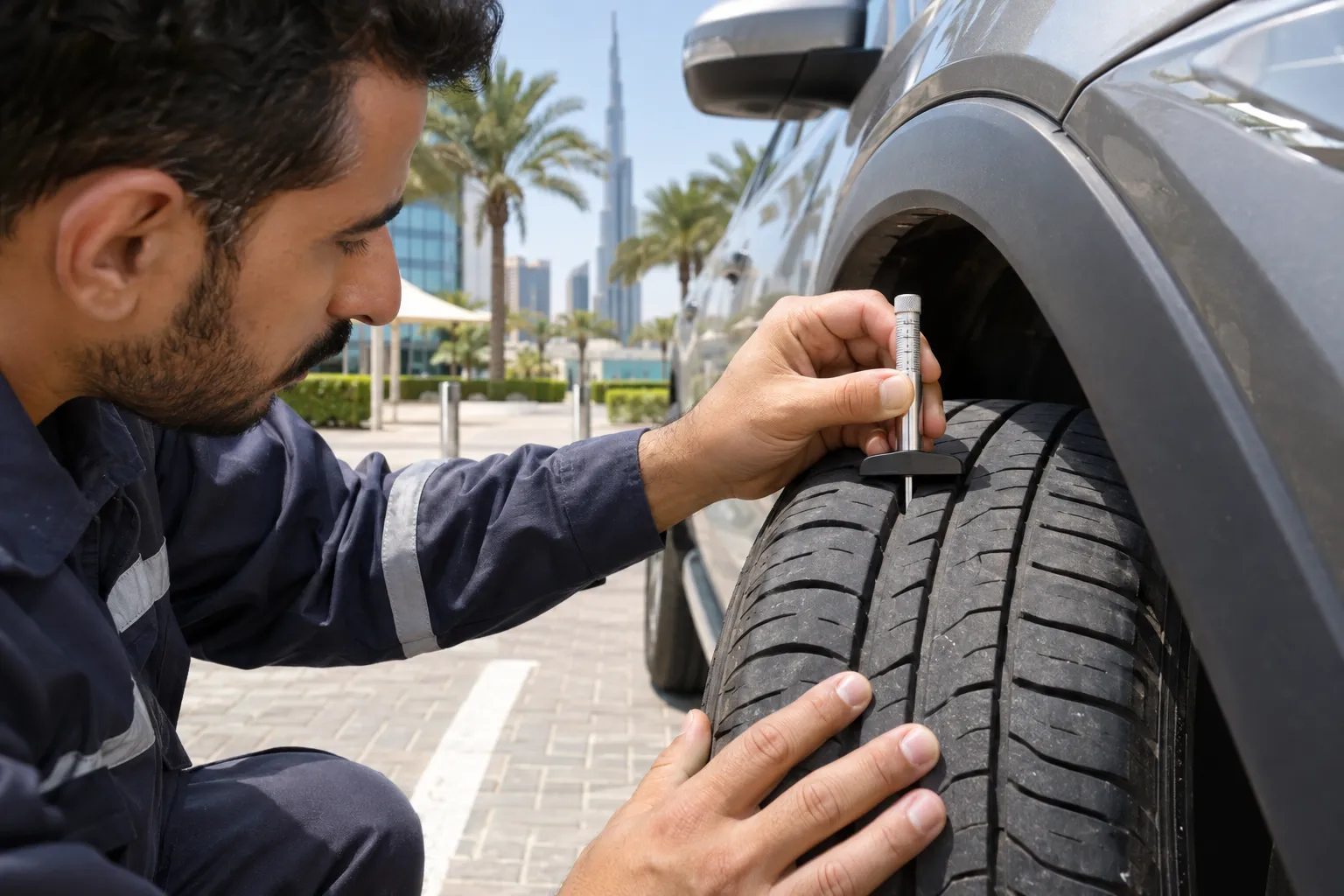
Measure it with a gauge in the main grooves, or compare the tread surface with the small wear bars moulded into the grooves. The UAE legal minimum is 1.6 mm. If the tyre is close to that, I’ll repair it if you ask, but I’ll also tell you it’s money you’ll spend again soon. Below 3 mm, a new tyre is often the better use of your money.
Question 6: How old is it?
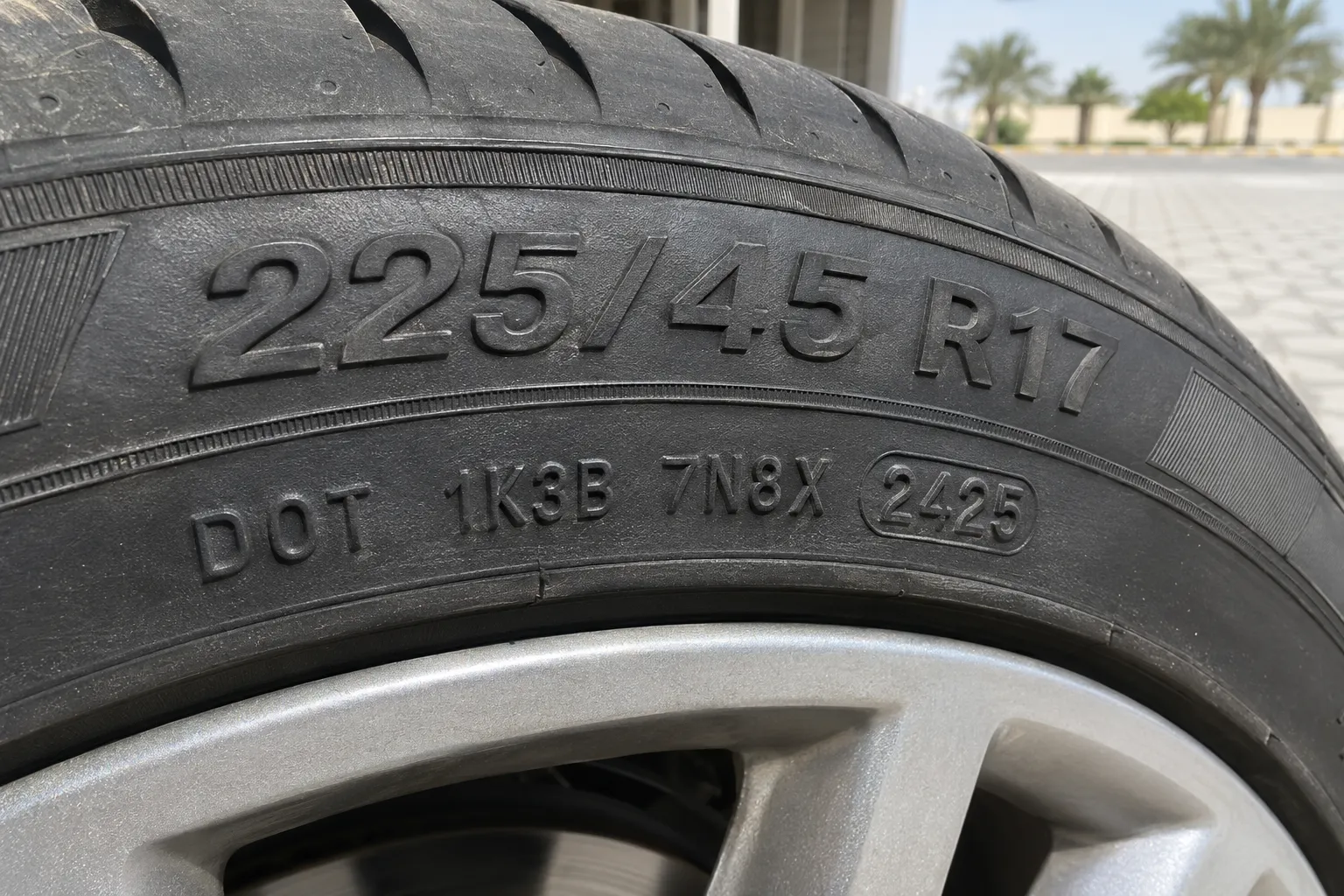
Check the four-digit DOT date on the sidewall. A tyre past five years from manufacture has reached the end of its usable life under the UAE guideline. If you’re not sure how to read it, see our guide to the DOT date code.
Quick reference: repair or replace?
| Situation | Verdict |
|---|---|
| Nail or screw, centre of tread, tyre not driven flat | Repair |
| Puncture in tread up to 6 mm, inner liner fine | Repair |
| Second puncture, well away from first repair | Repair |
| Puncture in shoulder or sidewall | Replace |
| Hole or cut larger than 6 mm | Replace |
| Any sign of driven-flat damage inside | Replace |
| Bulge, bubble or exposed cords | Replace |
| New puncture overlapping an old repair | Replace |
| Tread at or below 1.6 mm | Replace |
| Tyre over five years from manufacture | Replace |
| Run-flat driven on with no pressure | Replace (check manufacturer guidance) |
A case from last winter
A Nissan Sunny driver called us from the car park of a mall in Sharjah. He’d picked up a screw in the morning, the TPMS light came on, and he kept driving for the rest of the day because “it still felt fine”. When I got there the tyre was down to around 12 psi. The screw was dead centre in the tread, a textbook repair on its own. But once the tyre was off the rim, the inner sidewall had the tell-tale grey dust and a scuffed band all the way round. New tyre. If he’d stopped in the morning, he’d have paid for a repair instead.
What to do in the first five minutes
What you do straight after a puncture decides which side of the table you end up on. In order:
- Slow down gently and signal. Don’t brake hard or swerve.
- Get completely off the road, ideally at an exit, petrol station or car park. On a highway, the far right of the hard shoulder.
- Leave the object in. A screw left in place partly seals the hole and keeps the injury small. Pulling it out at the roadside just turns a slow leak into a flat.
- Check the pressure if you have a gauge. If it’s still holding most of its air, a short, slow drive to a workshop is reasonable. If it’s soft, stop.
- Look at the sidewall. Any bulge or cut there and the tyre is finished; fit the spare.
- Call for help if you can’t change the wheel safely. Our puncture repair near me page shows how quickly a van can reach you.
Most of the tyres I end up replacing could have been repaired if steps 1 and 2 had happened sooner.
What about run-flat tyres?
Run-flats are designed to be driven without air for a limited distance, so the “driven flat” rule applies to them by design. Some manufacturers don’t approve any repair; others allow a repair only if the tyre wasn’t driven deflated. I go through that in run-flat tyres: pros and cons.
Why some shops say yes when we say no
Customers sometimes tell me another shop would have plugged it. Some would. A plug in the shoulder or a tyre that’s been run flat will often hold air for a while, so it looks like a successful repair. The problem shows up later: a slow leak that comes back, or a casing that fails on a hot highway. We’d rather lose a AED 40 repair than send someone onto Emirates Road on a tyre we don’t trust.
If the answer is “replace”
It’s never the news anyone wants, but a tyre that fails the checklist is a risk on a road where 120 km/h is the norm. If it’s one tyre, we try to match the brand, pattern and size of the others. On AWD cars, the tread depth also needs to be close to the remaining tyres. Options start from AED 180–320 for budget 14–16” sizes; see new tyres.
Get an honest verdict
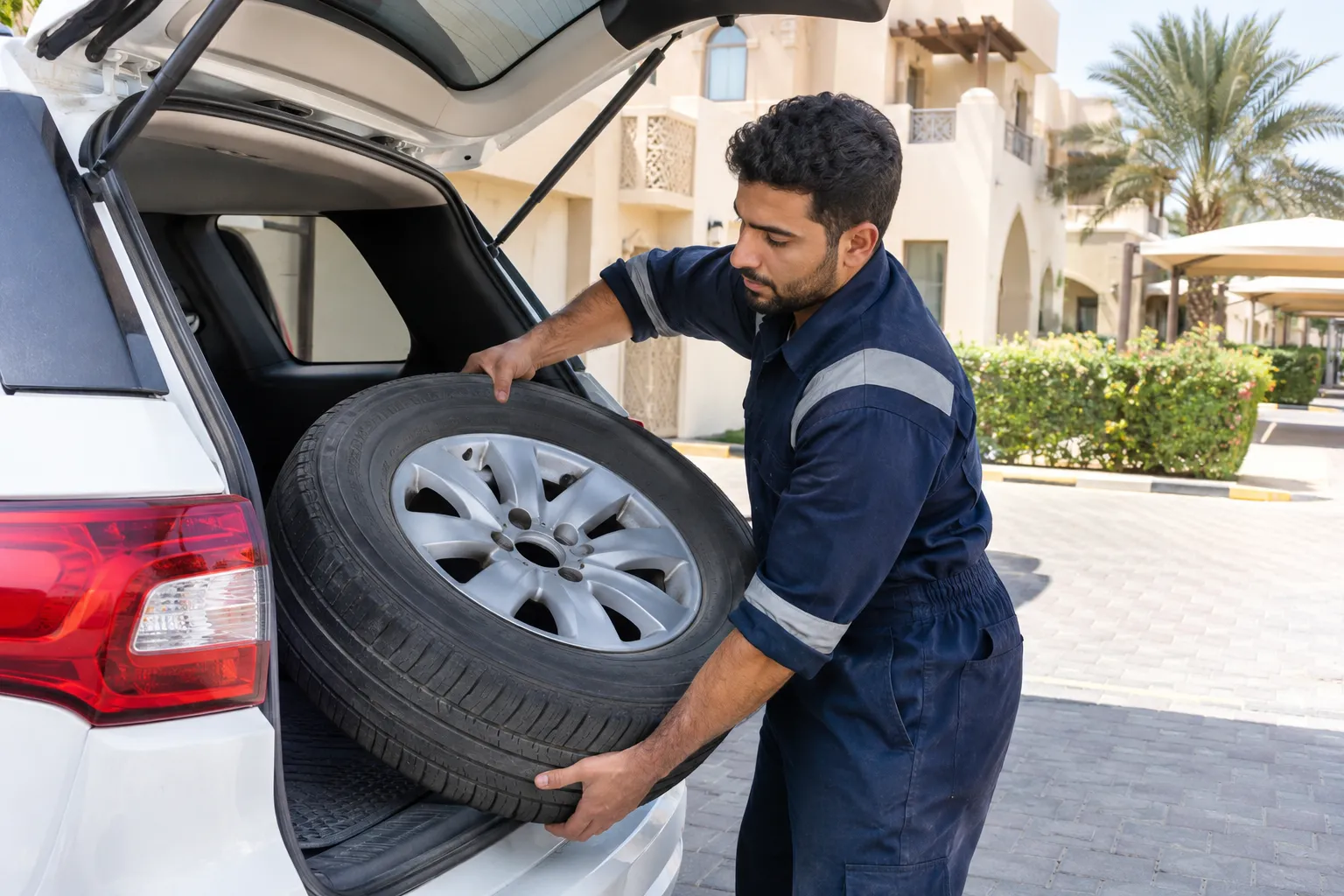
Whether your puncture is a simple screw or something worse, the only way to be sure is to look inside the tyre. Bring it to our Al Quoz workshop, or book a mobile puncture repair and we’ll come to you, check all six points, and tell you straight whether it’s a repair or a replacement.
Frequently asked questions
Can a sidewall puncture be repaired?
No. The sidewall flexes constantly and carries the load, so no plug or patch can hold there safely. A tyre with a nail, cut or bulge in the sidewall must be replaced.
How many times can a tyre be repaired?
There is no fixed legal number, but repairs must not overlap and need to be well spaced. In practice we stop at two repairs per tyre, and if a new puncture is close to an old repair, we recommend replacing the tyre.
Is a repaired tyre safe on the highway?
Yes, if it was repaired properly from the inside with a plug-patch after an inspection. A correctly repaired tyre keeps its original speed rating. A temporary external plug or sealant is different and should be followed by a proper repair.
Can run-flat tyres be repaired after a puncture?
Sometimes. If the tyre was not driven on with low pressure and the puncture is in the repairable area, it may be repairable, but manufacturers' policies differ and some do not allow it. We check the brand guidance and the inside of the tyre before deciding.
About the author
Fazir Kamal — Fazir Kamal is a tyre technician with five years of hands-on work on UAE roads — roadside punctures on Sheikh Zayed Road at 2 a.m., run-flat fitments in DIFC basements, alignment on desert-driven Patrols. He writes and reviews the technical guides on TyrePuncture.ae.