Buying Tyres
Run-Flat Tyres: Pros, Cons and Costs in the UAE
Run-flat tyres explained by a UAE technician: how far they go without air, honest pros and cons, repair rules, Dubai prices and whether to switch.
Run-flat tyres have reinforced sidewalls that hold the car up after a puncture, so you can keep driving, typically up to about 80 km at no more than 80 km/h, to a safe place or a tyre shop. The trade-offs are a firmer ride, higher prices, often shorter tread life, and stricter limits on repair.
A lot of the run-flats I see in Dubai are on BMWs, followed by some Mercedes-Benz and MINI models. Owners tend to either swear by them or can’t wait to switch. Both camps have a point.
Key takeaways
- Run-flats let you keep driving at reduced speed after a puncture; there’s no roadside wheel change.
- They need a working tyre pressure monitoring system, because you won’t feel the tyre go flat.
- Expect a firmer ride and a price around 20–50% above an equivalent standard tyre.
- Repair is possible only in limited cases and depends on the manufacturer.
- You can switch to standard tyres on most cars, but plan for punctures first.
How run-flats work
A standard tyre is held up by the air inside it. When the air goes, the sidewall collapses and the rim sits on the rubber. A self-supporting run-flat has a thick, heat-resistant rubber insert in each sidewall that can carry the car’s weight on its own for a limited distance.
Because the sidewall barely changes shape when pressure drops, you can’t see or feel a run-flat going soft. That’s why cars with run-flats must have TPMS. If your sensors are faulty, the system is effectively blind. Our TPMS sensor page covers replacements and programming.
The pros
1. No wheel change on the hard shoulder
This is the main reason they exist. Changing a wheel next to traffic at 120 km/h on the E311, or on a 47 °C afternoon, is genuinely dangerous. With run-flats you slow down and drive to the next exit, petrol station or our workshop.
2. Stability when a tyre fails
A standard tyre that loses air suddenly at highway speed can make the car hard to control. A run-flat keeps its shape, so the car stays more stable while you slow down.
3. More boot space and less weight
No spare wheel, jack or wheel brace in the boot. On some cars this frees a useful compartment under the floor.
4. Security at night
Not having to stop on a dark road or an isolated stretch outside the city is a real benefit, especially for drivers alone at night.
The cons
1. Firmer ride
Stiff sidewalls pass more of every expansion joint and speed bump into the cabin. On rough industrial area roads you’ll feel the difference. Newer generations are much better than early run-flats, but they’re still firmer than a standard tyre.
2. Higher price
Run-flats cost more to buy and more to fit. Expect AED 900–2,500 per tyre for premium sizes, plus AED 50–80 for fitting each one, compared with AED 30–45 for a standard 16” tyre.
3. Shorter life in many cases
The stiffer construction and heavier tyre often wear faster. On the cars I see, run-flats commonly give 10–20% fewer kilometres than a comparable standard tyre, though this varies a lot by brand and driving style.
4. Repair is limited
Many run-flats can’t be repaired once driven deflated, and some manufacturers don’t approve any repair at all. A screw that would cost AED 35–50 to fix in a standard tyre can mean a new run-flat.
5. Limited stock in some sizes
Common BMW sizes are easy to find in Dubai. Unusual sizes sometimes take a day or two to source.
6. Hidden damage
Because they feel normal at low pressure, drivers sometimes ignore the TPMS warning and keep driving for days. By the time they come in, the tyre is ruined.
Run-flat vs standard tyre at a glance
| Run-flat | Standard tyre | |
|---|---|---|
| After a puncture | Drive on, about 80 km at max 80 km/h | Stop, change wheel or call for help |
| Spare wheel needed | No | Yes, or sealant kit |
| Ride comfort | Firmer | Softer |
| Price (premium 18”) | AED 900–2,500 | AED 550–1,500 |
| Fitting cost per tyre | AED 50–80 | AED 30–45 (17”+: 50–80) |
| Repairable? | Only in limited cases | Usually, if in tread and under 6 mm |
| Needs TPMS | Yes | Recommended |
How to recognise a run-flat
Each brand uses its own code on the sidewall:
| Marking | Meaning / brand |
|---|---|
| RSC | Runflat System Component, BMW-approved run-flats from several makers |
| RFT | Run-Flat Tire, Bridgestone |
| ROF | RunOnFlat, used by Goodyear and Dunlop |
| SSR | Self-Supporting Runflat, Continental |
| ZP | Zero Pressure, Michelin |
| DSST | Dunlop Self-Supporting Technology |
| Run Flat / r-f | Pirelli and others |
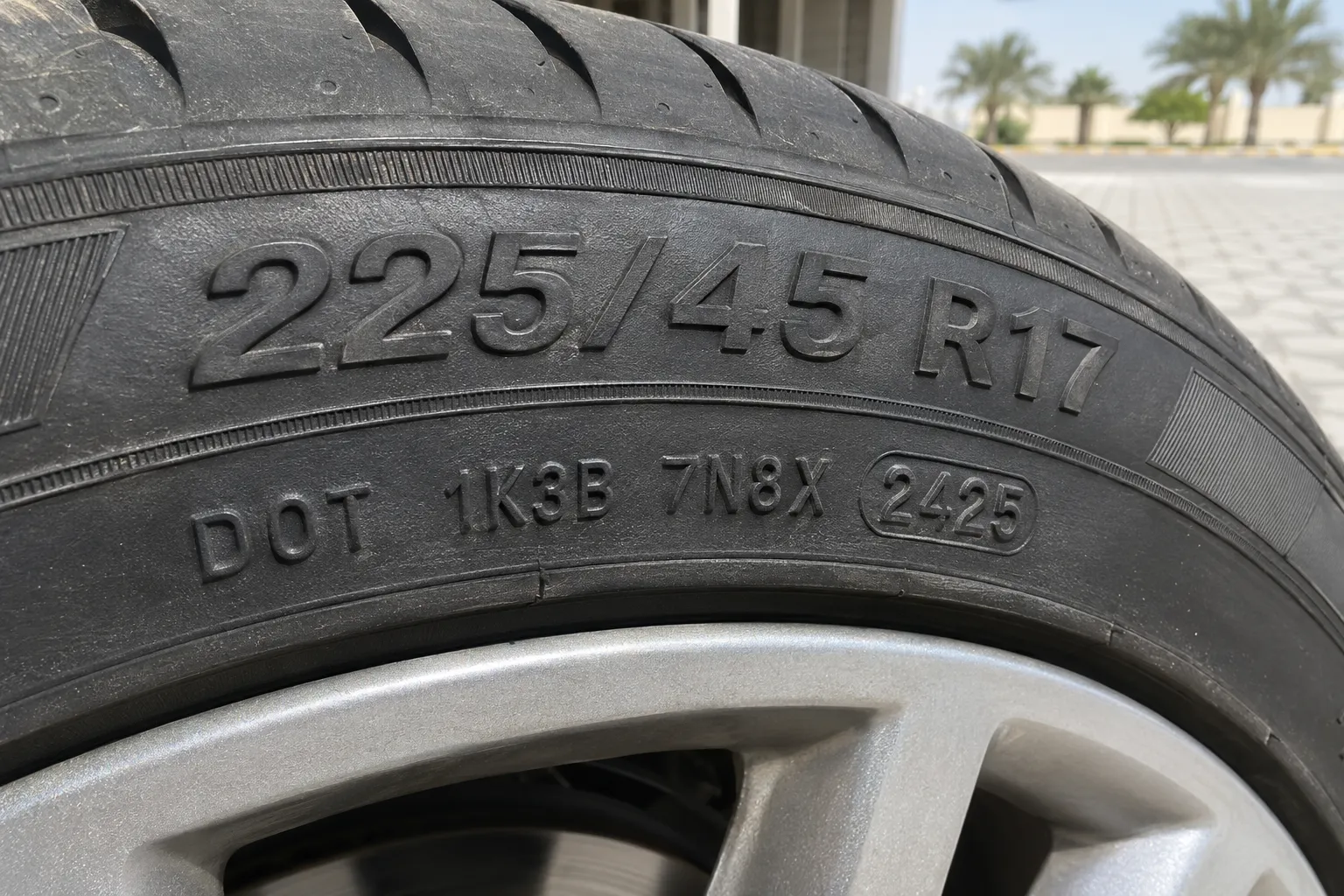
If you can’t find a marking, read the full sidewall; it’s sometimes small. Our guide to reading tyre sizes explains the other numbers you’ll see.
Can a punctured run-flat be repaired?
Sometimes. The tyre must meet all the usual conditions (tread puncture, up to about 6 mm, no previous overlapping repair) plus one more: it must not have been driven while deflated, because internal damage can’t be ruled out. We demount, inspect the inside, and check the manufacturer’s guidance for that specific tyre before deciding. If there’s any doubt, we’ll recommend replacement. The general rules are in can a punctured tyre be repaired.
Should you switch to standard tyres?
I get this question most weeks. My honest answer depends on how you drive.
Stay with run-flats if:
- You do a lot of highway driving, especially at night or alone
- You’d rather not change a wheel yourself
- The car has no space or mounting for a spare
- You want to keep the car exactly as the manufacturer specified
Consider switching if:
- Ride comfort matters more to you, and you mainly drive in the city
- You’re happy to carry a sealant and compressor kit or a space-saver spare
- You’re replacing all four tyres anyway and want to save money
A word on the switch itself: a space-saver spare needs somewhere to live, and on many BMWs the boot floor has no well for one. A compressor and sealant kit fits easily, but liquid sealant can clog a TPMS sensor, so use it only as a last resort. Some owners simply rely on a roadside service and a phone. That works in the city; it’s less comfortable on an empty stretch of the E11 at night.
If you switch, change all four at once rather than mixing run-flat and standard tyres on the car. Some cars have suspension settings tuned for run-flats; the change is legal and common but the handling will feel slightly different. Keep the TPMS working either way.
Caring for run-flats day to day
Run-flats need the same basics as any tyre, with a couple of extras. Check pressures with a gauge monthly, because you can’t judge them by eye. Make sure the TPMS has been reset after any tyre work. And don’t let anyone fit a run-flat on a basic tyre machine without the right mounting tools; a damaged bead on a AED 1,500 tyre is an expensive mistake.
Driving on a deflated run-flat: what to do
When the TPMS warning comes on in a car with run-flats, this is the routine I give customers:
- Check which tyre the display shows, if your car can show it, and the reading.
- Slow to 80 km/h or less and keep it smooth. No hard cornering or sudden braking.
- Head for the nearest safe stop, not your destination 70 km away. Distance limits are for ideal conditions; heat, a heavy load and high speed all shorten them.
- Take it easy over speed bumps and ramps. The sidewall is already working hard.
- Book the tyre in the same day. Tell the technician how far and how fast you drove on it, honestly. It decides whether repair is even an option.
Summer makes this more urgent. A deflated run-flat on 60 °C asphalt builds heat in its sidewall faster than it would on a mild day, so treat the advertised distance as a maximum, not a target.
Popular run-flat options
Bridgestone, Pirelli, Michelin, Continental and Goodyear all make run-flats in common UAE sizes. For BMWs, look for the star symbol (*) on the sidewall, which shows the tyre was approved by BMW for that model, alongside the RSC run-flat marking. Our run-flat tyres in Dubai page lists current sizes and prices.
Get the right tyres fitted
Run-flats need the right machine and a technician who’s done hundreds of them; their stiff sidewalls can damage a bead or a sensor if fitted carelessly. Book new tyres with us and we’ll fit, balance and reset your TPMS, at our Al Quoz workshop or at your home.
Frequently asked questions
How far can you drive on a run-flat tyre with no air?
Typically up to about 80 km at no more than 80 km/h, but limits vary by tyre and car maker, and heat and load reduce them. Check your owner's manual and treat it as a distance to the nearest safe place, not a normal drive.
Can I replace run-flat tyres with normal tyres?
Yes, on most cars, as long as the size, load index and speed rating match. You'll need a plan for punctures, such as a spare wheel or a sealant and compressor kit, because most run-flat cars have no spare.
How do I know if my car has run-flat tyres?
Look for markings on the sidewall such as RSC, ROF, RFT, SSR, ZP, DSST or the words Run Flat. BMWs and some Mercedes and MINI models often come with them as standard.
How much do run-flat tyres cost in Dubai?
Premium run-flat tyres fitted with us cost about AED 900–2,500 each depending on size and brand. Fitting a run-flat on its own costs AED 50–80 per tyre because the stiff sidewall needs specialist equipment.
About the author
Fazir Kamal — Fazir Kamal is a tyre technician with five years of hands-on work on UAE roads — roadside punctures on Sheikh Zayed Road at 2 a.m., run-flat fitments in DIFC basements, alignment on desert-driven Patrols. He writes and reviews the technical guides on TyrePuncture.ae.