Alignment & Balancing
8 Signs You Need a Wheel Alignment (and Quick Tests)
Eight signs your car needs a wheel alignment, with simple tests you can do yourself, the UAE road hazards that knock alignment out, and what it costs in Dubai.
The most common signs you need a wheel alignment are the car pulling to one side, a steering wheel that’s off-centre when you drive straight, and tyres wearing faster on one edge. You might also hear tyres squealing at low speed, or notice the steering feels loose or doesn’t return to centre after a turn.
Alignment drifts slowly, so most drivers get used to it. Below are the eight signs I look for, and for each one a quick test you can do yourself before booking anything.
Key takeaways
- Pulling, an off-centre wheel and uneven wear are the big three.
- Vibration is usually balancing, not alignment.
- Speed bumps, kerbs and potholes are the main causes here.
- Check alignment yearly and after new tyres or any heavy impact.
- Alignment costs AED 120–180; a set of tyres worn out by misalignment costs much more.
The eight signs
1. The car pulls to one side
What you notice. You have to hold the steering slightly left or right to keep straight.
What’s happening. Usually a toe or camber difference between the left and right wheels, though a soft tyre or a sticking brake can feel the same.
Quick test. Check all four tyre pressures first. Then, on a flat, empty car park at 20–30 km/h, let go of the wheel for two or three seconds. If the car curves clearly to one side, book an alignment. Don’t do this test on a public road with a camber; many UAE roads slope towards the edge for drainage and every car will drift slightly that way.
2. The steering wheel is crooked when driving straight
What you notice. The logo on the wheel is tilted while the car goes straight.
What’s happening. The front toe has been knocked out, or the steering was centred badly at a previous alignment.
Quick test. Drive straight on a level road and glance at the wheel. Even 5 degrees off centre is worth correcting.
3. One edge of the tyre is wearing faster
What you notice. The inner or outer shoulder of a tyre looks smooth while the rest has good tread.
What’s happening. Inner-edge wear points to excessive negative camber or toe-out; outer-edge wear usually to toe-in or positive camber.
Quick test. Turn the steering to full lock and look at the inner edge of the front tyres, which is the part people never see. Run your palm across the tread. A sharp, feathered edge on one side of each block is a classic toe problem.
4. Feathered or saw-tooth tread
What you notice. Stroking the tread one way feels smooth; the other way feels rough.
What’s happening. The tyre is being dragged sideways slightly as it rolls, which is exactly what incorrect toe does.
Quick test. Your hand is the test. Compare front and rear tyres.
5. Tyres squeal on slow corners
What you notice. A squeal on basement ramps, roundabouts or tight car park turns at low speed.
What’s happening. Scrubbing from incorrect toe. Polished concrete in mall car parks makes it worse.
Quick test. If it’s new and the tyres are correctly inflated, alignment is a likely cause.
6. Steering doesn’t return to centre
What you notice. After a turn, the wheel stays turned instead of unwinding by itself.
What’s happening. Caster may be out, often after a heavy hit, or there’s a worn steering or suspension part.
Quick test. At low speed, make a 90-degree turn and relax your grip. The wheel should come back most of the way on its own.
7. Loose or wandering steering
What you notice. The car needs constant small corrections on the highway, especially in crosswinds on open stretches like the E11 near Ghantoot.
What’s happening. Alignment, worn track-rod ends or worn bushings. An alignment check includes a look at these parts.
8. You’ve just hit something hard
What you notice. Nothing yet, perhaps. But you took a speed bump at 50 km/h, clipped a kerb parallel parking, or dropped a wheel into a pothole.
What’s happening. A hard impact can bend a tie rod or shift a setting instantly.
Quick test. Check the steering wheel position on your next straight drive. If it’s changed, don’t wait for the tyres to tell you.
The signs at a glance
| Sign | Likely alignment angle | Also check |
|---|---|---|
| Pull to one side | Toe or camber difference | Tyre pressure, brakes |
| Off-centre steering wheel | Front toe | Recent kerb hit |
| Inner-edge wear | Negative camber, toe-out | Worn bushes, lowered suspension |
| Outer-edge wear | Toe-in, positive camber | Hard cornering habit |
| Feathered tread | Toe | Rotation history |
| Squeal at low speed | Toe | Pressures |
| Wheel won’t return to centre | Caster | Steering components |
| Wandering on the highway | Toe, caster | Track-rod ends, bushings |
What’s not an alignment problem
A vibration through the steering wheel or seat at 90–120 km/h is almost always wheel balance, a bent rim, or a damaged tyre. Shuddering only when braking points to brake discs. People often book an alignment for a vibration and are disappointed when it doesn’t go away. I explain how to tell them apart in wheel balancing vs alignment.
Why alignment goes out so often in the UAE
From what I see every week:
- Speed bumps in residential communities like JVC, Al Barsha and the Sharjah suburbs, especially taken at speed.
- Kerbs in tight car parks and parallel parking in older areas like Deira and Bur Dubai.
- Potholes and broken edges on industrial area roads, including our own neighbourhood in Al Quoz.
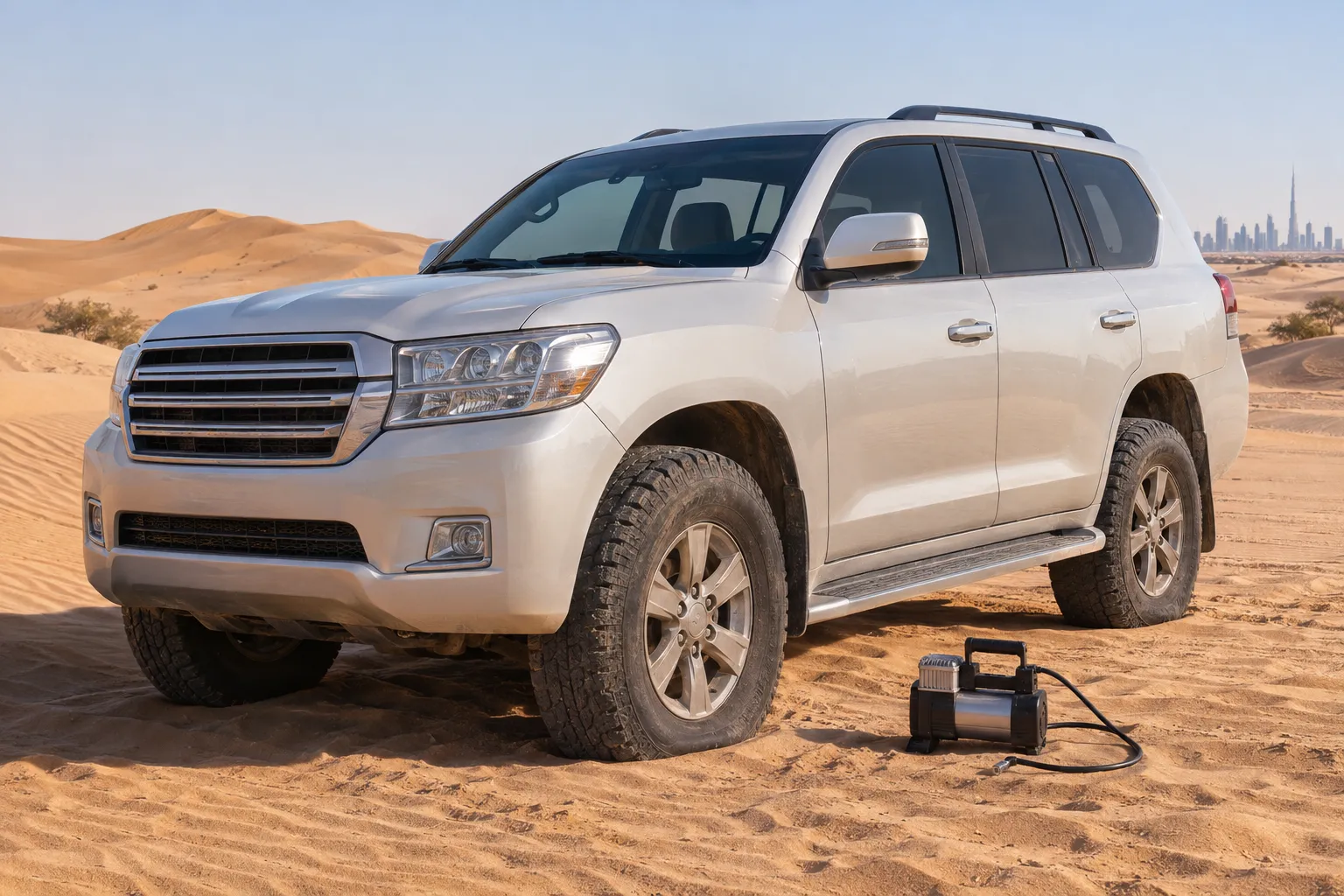
- Desert driving: dune bashing loads the suspension heavily. A check after every trip is sensible for regular off-roaders; see tyres for desert driving.
- Lowering kits and wheel changes, which change geometry.
What happens during an alignment
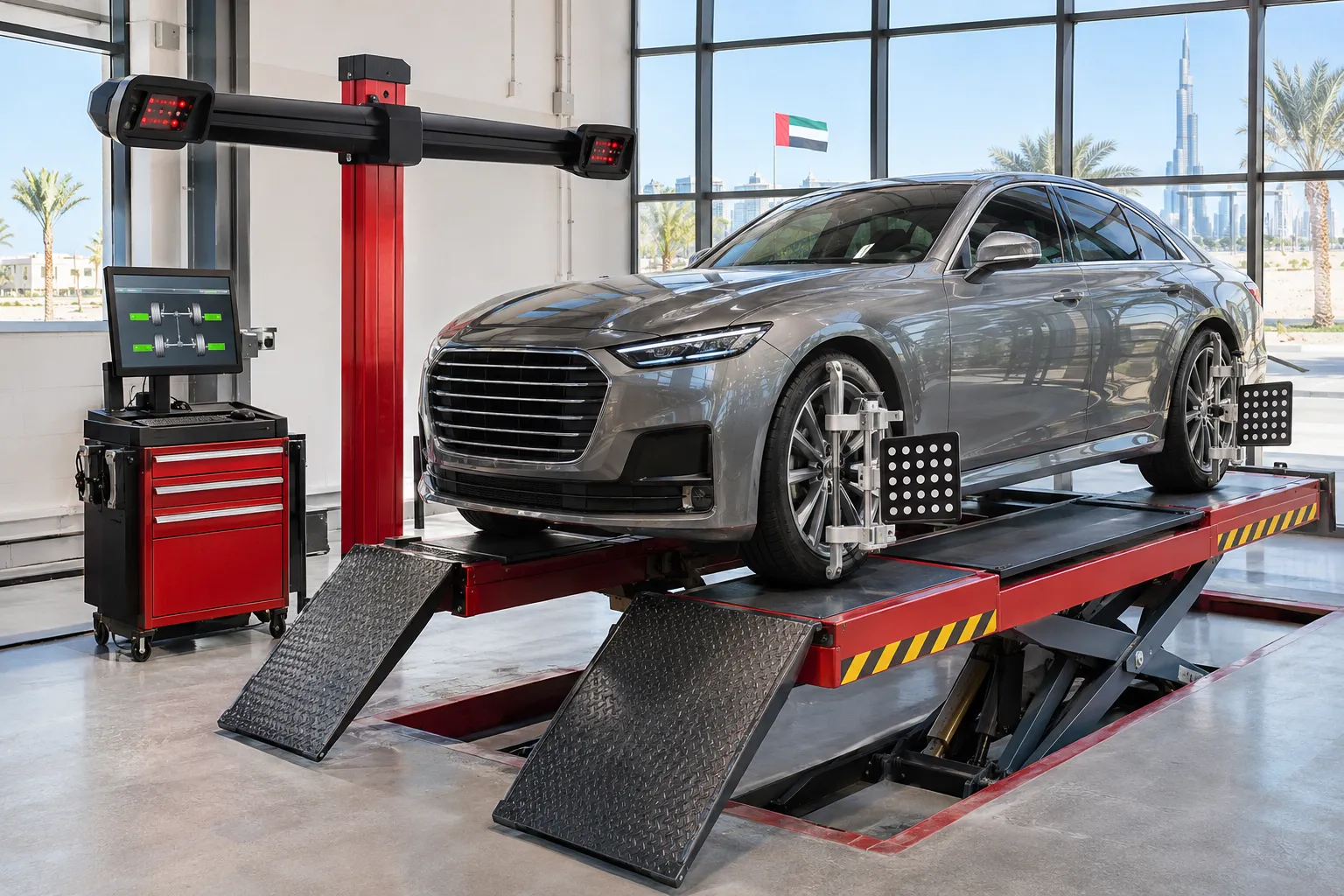
On our machine the process takes 45–60 minutes:
- Check tyre pressures, tyre condition and steering and suspension parts for play.
- Mount sensors or targets on each wheel.
- Measure toe, camber and caster against the manufacturer’s specification for your model.
- Adjust the front toe (and rear on cars where it’s adjustable), and camber or caster where possible.
- Centre the steering wheel.
- Road test and print the before-and-after readings for you.
If a part is worn or bent, we’ll show you before doing anything. Aligning a car with a worn track-rod end is wasted money.
Reading the alignment report
At the end you get a printout with two columns, before and after, and three rows of angles for each wheel. Here’s how to read it without a technician:
- Green figures are inside the manufacturer’s tolerance. Red ones are outside.
- Total toe is the one that eats tyres. Small numbers matter here; a few tenths of a degree out is enough to wear an edge.
- Camber on many cars, especially front-wheel-drive sedans, is not adjustable without extra parts. If it’s red and can’t be adjusted, the report tells us something is bent or worn.
- Cross values compare left to right. A big difference between sides is what makes a car pull.
Ask for the printout every time. If a shop can’t give you before-and-after readings, you have no way to know what was done.
How often to check
- Once a year or every 10,000–15,000 km
- Whenever you fit new tyres; it’s the cheapest way to protect them
- After any steering or suspension work
- After a heavy impact
- When you notice any of the signs above
The cost of ignoring it
A toe setting that’s slightly out can wear the inside edge of a pair of front tyres in 10,000–15,000 km. For a mid-range 17” tyre at AED 320–600 each, that’s far more than the AED 120–180 for an alignment. Our tyre performance guide explains how wear patterns affect grip and braking.
Alignment on lifted, lowered and modified cars
Modified cars need extra care. A lift kit on a Wrangler or a Hilux changes caster and camber, and the factory figures may no longer be achievable without adjustable arms. Lowering springs on a sedan usually add negative camber, which wears the inner edges. In both cases, tell the technician about the modification before the alignment starts so the targets can be set sensibly rather than chasing numbers the car can’t reach.
Book a check
If two or more of these signs sound familiar, it’s worth a look. Find us via wheel alignment near me, or book wheel alignment at our Al Quoz workshop: AED 120 for sedans, AED 180 for SUVs and 4x4s, with the before-and-after report included.
Frequently asked questions
How often should I get a wheel alignment in the UAE?
Once a year or every 10,000–15,000 km is a good routine, plus after fitting new tyres, after suspension or steering work, and after any hard hit on a kerb, pothole or speed bump.
Can bad alignment cause vibration?
Not usually. Vibration at speed is almost always a balancing problem, a damaged tyre or a bent rim. Alignment problems show up as pulling, an off-centre steering wheel and uneven tyre wear.
How much does wheel alignment cost in Dubai?
With us, wheel alignment costs AED 120 for a sedan and up to AED 180 for an SUV or 4x4. Alignment with balancing on all four wheels is AED 199–249.
Is it normal for a car to drift slightly to the left in the UAE?
A slight drift towards the kerb side can come from road camber, which is designed to drain water. Test on a flat road or a car park. If the pull is there on level ground, get the alignment checked.
About the author
Fazir Kamal — Fazir Kamal is a tyre technician with five years of hands-on work on UAE roads — roadside punctures on Sheikh Zayed Road at 2 a.m., run-flat fitments in DIFC basements, alignment on desert-driven Patrols. He writes and reviews the technical guides on TyrePuncture.ae.