Driving in the UAE
Flat Tyre on the Highway in the UAE: What to Do
Got a flat tyre on Sheikh Zayed Road or the E11? A technician's step-by-step on stopping safely, where to wait, when to change it and when to call for help.
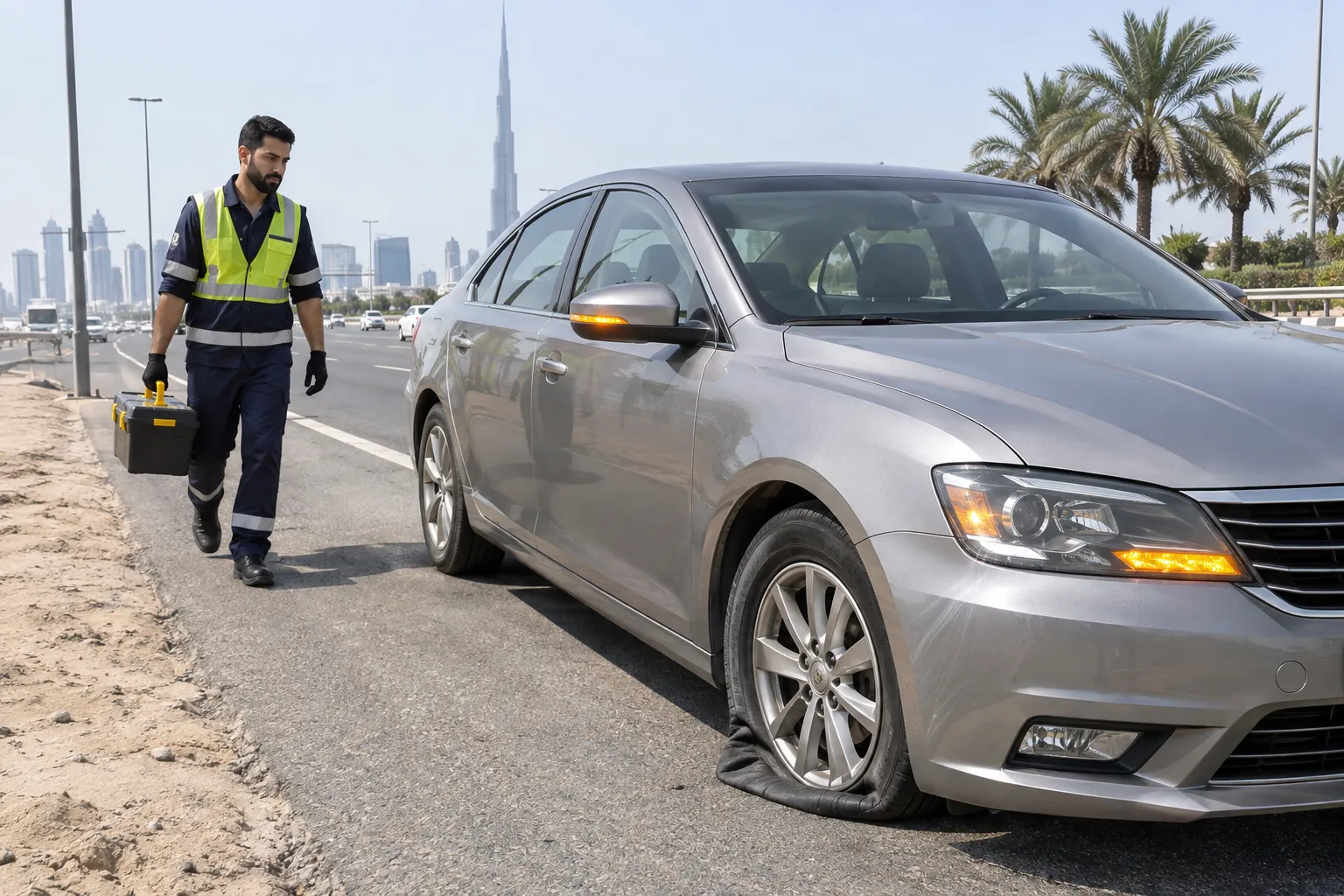
If you get a flat tyre on a UAE highway, hold the wheel firmly, ease off the accelerator without braking hard, switch on your hazard lights and move to the right-hand hard shoulder, or better, roll slowly to the next exit or safe area. Once stopped, get everyone out on the side away from traffic and wait behind the barrier. Only change the tyre yourself if you’re well clear of the traffic lane; otherwise call for roadside help.
Key takeaways
- Don’t brake hard or swerve when a tyre goes. Let the car slow down in a straight line.
- The hard shoulder is for emergencies only, and it’s dangerous. Get off the highway if you can roll there slowly.
- People on the hard shoulder are hit every year in the UAE. Wait behind the barrier, not beside your car.
- If the flat is on the traffic side, don’t change it there. Call 999 if you’re blocking a lane.
The first ten seconds: when the tyre goes
A sudden flat on a fast road feels violent: a loud bang or flapping noise, the steering pulling to one side, the car wallowing. What you do now matters most.
- Grip the wheel with both hands. The car will pull toward the flat tyre. Hold it straight.
- Don’t stamp on the brake. Hard braking on a flat or burst tyre shifts weight and can spin the car. Let the speed drop on its own.
- Lift off the accelerator gently. Some instructors even suggest a light, brief press to keep the car stable in a blowout, before slowing down. The key word is gently.
- Switch on your hazard lights once the car is under control.
- Check your mirrors and indicate right before moving across. On Sheikh Zayed Road, Emirates Road and the E11, traffic behind you may still be doing 120 km/h.
The next minute: where to stop
This is the decision most people get wrong. The instinct is to stop immediately. Often the safer choice is to keep rolling slowly for a few hundred metres.
| Situation | Best option |
|---|---|
| Exit, petrol station or wide lay-by within about 1 km | Roll there at 20–30 km/h with hazards on |
| No exit nearby, wide hard shoulder | Stop as far right as possible, wheels turned away from traffic |
| Narrow shoulder, bridge, tunnel or bend | Keep rolling slowly to a wider section if the car allows |
| Car won’t move, stuck in a live lane | Hazards on, get out on the safe side, get behind the barrier, call 999 |
Yes, rolling on a flat will destroy the tyre and can scrape the rim. A rim repair costs from AED 150; a hospital trip costs a lot more. Run-flat tyres are designed for this and will usually go up to about 80 km at 80 km/h. See how run-flat tyres work if you’re not sure what your car has.
Once you’ve stopped
Get people out safely
- Everyone exits on the side away from traffic, usually the passenger side.
- Move behind the crash barrier or well up the verge. Don’t stand between your car and the traffic, and don’t stand in front of the car either.
- Keep children and pets with you, away from the road.
- In summer, take water. A 45-minute wait on a sunny shoulder in August is a health risk in itself.
Make the car visible
- Hazard lights stay on.
- If it’s safe to walk back along the verge, place your warning triangle well behind the car to give approaching traffic time. If it isn’t safe, skip it.
- At night, keep the sidelights on as well.
Call the right number
- 999: if anyone is injured, the car is in a live lane or you feel unsafe.
- 901: Dubai Police non-emergency line.
- Your mobile tyre service for the repair itself. Share your live location pin, which side of the road you’re on, and the nearest exit number.
Dubai Police have stressed that the hard shoulder is only for genuine emergencies like a breakdown and that drivers should move to the nearest safe parking area where possible. Abu Dhabi Police advise staying on the right shoulder if the car can’t be moved. Both say the same thing underneath: get out of the flow of traffic and stay visible.
Should you change the tyre yourself?
Changing a wheel is straightforward on a quiet street. On a highway shoulder it’s a different job. Ask yourself:
- Which side is the flat on? If it’s the left (traffic-side) wheel, you’ll be kneeling with your back to vehicles passing a metre away. Don’t.
- How wide is the shoulder? You need room to kneel and work without leaning into the lane.
- Is the ground firm? A jack on soft sand at the edge of the E311 can slip.
- Do you have a usable spare, a jack and the locking-nut key? Many cars now come with only a repair kit.
- Is it dark, hot or are you alone?
If any answer worries you, wait for help. If you’re in a safe spot and want to do it, our step-by-step guide to changing a tyre shows the correct order, including loosening the nuts before you jack the car.
What about the tyre repair kit?
Many newer cars carry a sealant bottle and a small compressor instead of a spare. It can get you moving with a simple nail-type puncture in the tread. It won’t help with a sidewall cut, a burst tyre or a tyre that came off the rim. After using sealant, drive gently (most kits say under 80 km/h) and get the tyre checked within a day; the sealant makes a later plug or patch messier, and some tyre shops won’t repair a sealed tyre at all.
What I see on the roadside
Most of my highway call-outs come in a few patterns:
- Nail or screw punctures picked up near construction zones in Al Quoz, Jebel Ali or Mussafah, then going flat at speed 10 minutes later.
- Summer bursts on cars that were already low on pressure.
- Sidewall damage after hitting debris; lorry tyre treads on the E11 are a common culprit.
- Flat spares. At least one call a week is someone who changed the wheel correctly and then found the spare at 10 psi.
Last August I reached a family on Emirates Road near the Sharjah border just after noon. The father had started changing the rear right wheel, the one nearest traffic, with the kids sitting in the car with the engine off. We moved everyone behind the barrier with water, I swapped to the spare in about ten minutes, and they followed me at low speed to the next exit where I plugged the original tyre properly. Nothing dramatic happened, and the point is to keep it that way.
Night, heat and other special cases
At night
Visibility is the main danger. Keep hazards and sidelights on, wear something light-coloured if you have it, and don’t use your phone torch while standing near the lane. If you’re on a dark stretch of the E311 or the Al Ain road, wait for help behind the barrier rather than attempting a wheel change.
In midsummer heat
Between June and September, an hour on the shoulder can be dangerous for children, older passengers and pets. If it’s safe to stay in the car with the engine running and air conditioning on, well off the lane, that may be the better choice than standing in the sun; if the car could be hit, get out and find shade behind the barrier. Always carry water.
Run-flat tyres
Run-flats change the plan. You can usually keep driving to an exit or tyre shop at reduced speed, but the warning light is your only sign of a puncture. Don’t push the distance limit printed in your manual. Many run-flats can’t be repaired after being driven flat; our team carries common run-flat tyres for replacement.
With a trailer or caravan
A flat on a towing vehicle or trailer needs extra room. Never try to change a trailer wheel on a narrow shoulder.
After the flat: what to check
Once you’re off the highway:
- Get the tyre inspected inside and out. Driving on a flat can damage the inner sidewall even when the outside looks fine. Our guide on whether a punctured tyre can be repaired explains the limits.
- Don’t drive far on a space-saver spare. Most are limited to 80 km/h and short distances.
- Check the rim for bends or cracks if you drove on the flat.
- Re-check wheel nut tightness after about 50 km if you changed the wheel yourself.
- Check the other tyres’ pressure and the spare’s.
Roadside help across Dubai, Sharjah and Abu Dhabi
Our vans run 24/7 and come to you on the highway, in a car park or outside your villa. We can plug a tread puncture on the spot, fit your spare, or bring a new tyre in your size. Mobile repair starts at AED 99–149 including the call-out, with a AED 50 night supplement between 22:00 and 06:00. Call for roadside flat tyre help in Dubai, or read more about our flat tyre repair service before you need it.
Frequently asked questions
Is it safe to change a tyre on the hard shoulder of Sheikh Zayed Road?
Usually not, especially if the flat is on the traffic side of the car. Dubai Police have repeatedly warned about people being hit on the hard shoulder. If you can roll slowly to an exit, petrol station or wide area, do that; otherwise stay safe behind the barrier and call for help.
Can I drive on a flat tyre to the next exit?
For a short distance at very low speed with hazards on, yes, if it gets you somewhere safe. You will probably ruin the tyre and may damage the rim, but a tyre is cheaper than standing in a live lane. Run-flat tyres can usually do up to about 80 km at 80 km/h.
Who do I call for a flat tyre on a UAE highway?
If you are in danger or blocking a lane, call 999. For non-emergency police help in Dubai, 901. For the tyre itself, call a mobile tyre service; we cover Dubai, Sharjah and Abu Dhabi 24/7.
How long does a mobile tyre van take to reach me on the highway?
It depends on where the nearest van is, the time of day and traffic. When you call, we give you an estimated arrival time before dispatching. Share your live location pin so the technician finds you on the correct side of the road.
About the author
Fazir Kamal — Fazir Kamal is a tyre technician with five years of hands-on work on UAE roads — roadside punctures on Sheikh Zayed Road at 2 a.m., run-flat fitments in DIFC basements, alignment on desert-driven Patrols. He writes and reviews the technical guides on TyrePuncture.ae.