Tyre Pressure
Nitrogen vs Air in Tyres: Is It Worth It in the UAE?
Does nitrogen in tyres help in UAE heat? A technician tests the claims on pressure loss, fuel, tyre life and bursts, and explains when it's worth AED 10.
Nitrogen is slightly better than air for keeping tyre pressure stable, because it leaks through rubber more slowly, but it won’t stop a tyre bursting or dramatically improve fuel economy. In the UAE it’s worth the small cost if you rarely check your pressures. If you check monthly with a gauge, plain air does almost the same job.
Key takeaways
- Normal air is already about 78% nitrogen; a nitrogen fill raises that to roughly 93–98%.
- The main real benefit is slower pressure loss over weeks, not higher grip or cooler tyres.
- Nitrogen and air expand with heat almost identically, so hot-tyre pressure rise in summer is about the same.
- Mixing nitrogen and air is safe. Wrong pressure is the real danger.
Nitrogen vs air at a glance
| Factor | Compressed air | Nitrogen fill | What it means for you |
|---|---|---|---|
| Nitrogen content | ~78% | ~93–98% (depends on generator) | Higher purity = slower leakage |
| Pressure loss through rubber | Normal | Somewhat slower | Fewer top-ups between checks |
| Pressure rise when hot | ~1 psi per 5–6 °C | Practically the same | Both rise on hot UAE roads |
| Moisture inside the tyre | Can contain water vapour | Dry | Slightly less rim/valve corrosion |
| Cost | Free at most stations | AED 10 per tyre with us | Small, one-off cost |
| Availability | Every petrol station | Workshops and some stations | Air is easier on a road trip |
| Safety for mixing | — | Safe to top up with air | No need to “purge” again |
What nitrogen actually does
Rubber is not perfectly airtight. Gas molecules slowly pass through the inner liner and sidewall. Oxygen does this faster than nitrogen, so a tyre filled with ordinary air loses pressure a little quicker than one filled with high-purity nitrogen.
An often-quoted year-long US consumer test found tyres filled with air lost about 3.5 psi on average, compared with about 2.2 psi for nitrogen. That’s a real difference, but it’s 1.3 psi over twelve months. Anyone who checks their pressures monthly would never notice it.
Nitrogen from a generator is also dry. Compressed air from a cheap compressor can carry moisture, which over years can contribute to corrosion around the valve and the inside of alloy rims. In a dry climate like ours, that’s a minor effect, but it’s real on older steel wheels.
Claims tested one by one
“Nitrogen keeps tyres cooler in the heat”
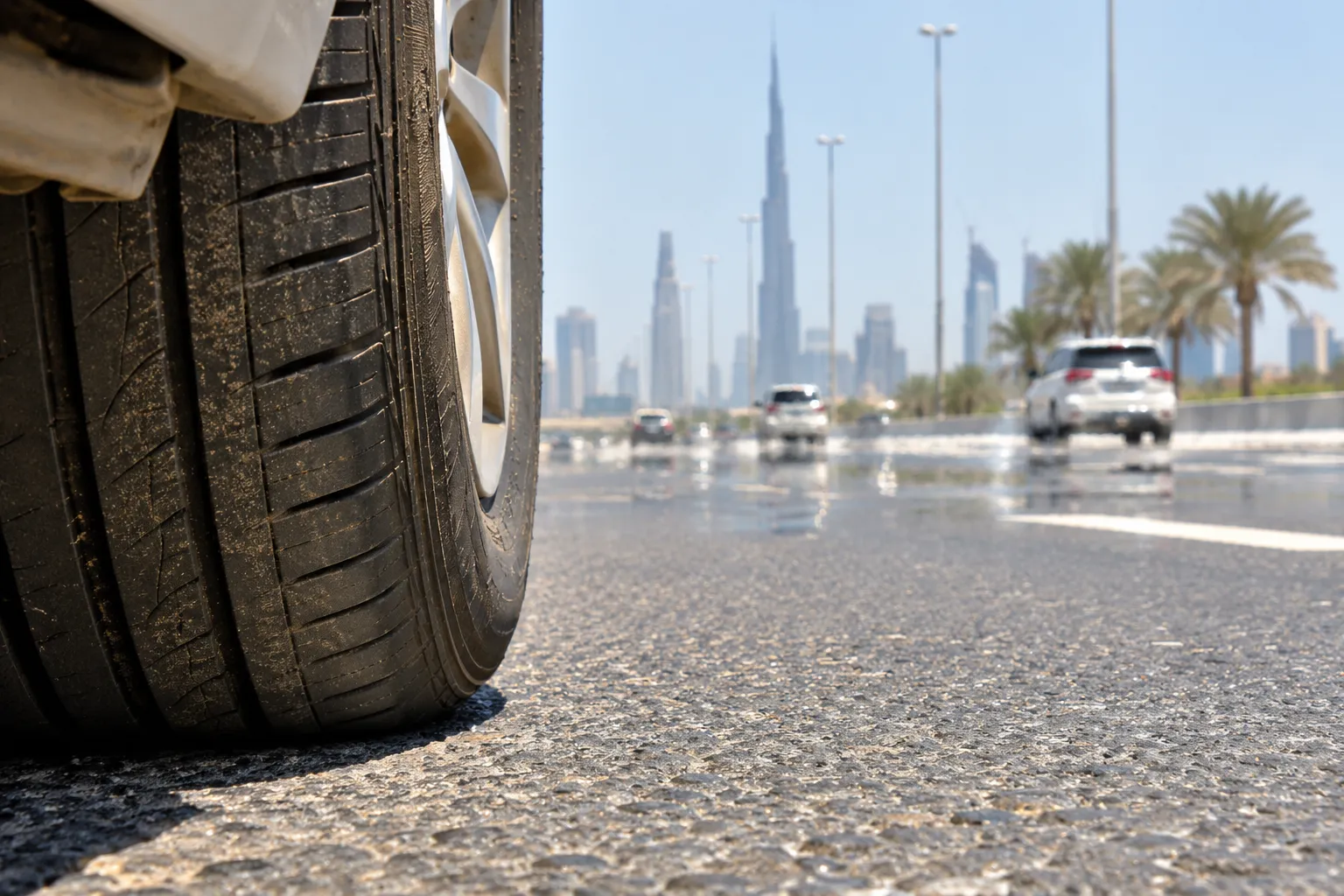
Not true in any meaningful way. Both air and nitrogen follow the same gas laws. On a 47 °C afternoon with asphalt at 65 °C, a tyre at 32 psi cold will rise to roughly 36–38 psi whether it’s filled with air or nitrogen. I’ve measured this side by side on our own vans.
“Nitrogen saves fuel”
Only indirectly. Under-inflated tyres increase rolling resistance and fuel use. If nitrogen helps you stay closer to the correct pressure, you’ll save a little fuel. If you already keep the right pressure with air, the saving is close to zero.
“Nitrogen makes tyres last longer”
Again, only through better pressure. Under-inflation wears the outer shoulders and builds heat; over-inflation wears the centre. Stable pressure helps even wear. The gas itself doesn’t harden or soften the rubber.
“Nitrogen prevents bursts”
This is the claim that worries me most, because people believe it and stop checking. Most summer bursts I attend are on tyres that were already low, overloaded, old, or damaged by a kerb hit. Nitrogen does none of those jobs for you. Read why tyres burst in summer for the full list.
“Race teams and aircraft use it, so it must be better”
They use it mainly because it’s dry and predictable, and in aircraft because it doesn’t support combustion. A family car on Al Khail Road doesn’t share those needs.
Who actually benefits from nitrogen in the UAE?
I recommend it in a few cases:
- Drivers who almost never check their tyres. If you’ll only look at your pressures when a warning light comes on, slower leakage is genuinely useful.
- Cars that sit for long periods. Expat cars parked in a basement during a two-month summer holiday come back with less pressure loss.
- Cars with TPMS that triggers often. A little more stability means fewer nuisance warnings. Learn what the light means in our guide to the TPMS warning light.
- Fleet vehicles, where small gains across many cars add up and checks are scheduled.
And where I tell people not to bother paying extra:
- You check pressures with your own gauge every couple of weeks.
- You often do long trips where only air will be available for top-ups.
- You’re about to replace the tyres anyway.
How a proper nitrogen fill is done
A quick top-up of nitrogen on top of existing air gives you a mix of maybe 85% nitrogen, which is only a small step up from normal air. When we do a proper fill at the workshop:
- Check the tyres for punctures, nails and valve leaks first. Nitrogen in a leaking tyre is money wasted.
- Let the tyres cool if the car has just been driven.
- Deflate each tyre down to a low pressure (not fully to zero on the rim).
- Refill with nitrogen from the generator.
- Repeat the deflate/refill cycle once more to raise purity.
- Set to the pressure on your door placard and fit green valve caps so the next technician knows.
The whole job takes 15–20 minutes for four tyres. It’s AED 10 per tyre, and we include it free with every set of new tyres.
What nitrogen costs over a year
People sometimes treat nitrogen as an expensive extra. In reality the costs are small either way:
| Option | Up-front cost (4 tyres) | Ongoing cost | Effort |
|---|---|---|---|
| Air, checked monthly by you | AED 0 | AED 0 (free at stations) | 10 minutes a month |
| Nitrogen fill, topped with nitrogen | AED 40 | AED 10 per tyre each top-up | Need a nitrogen station |
| Nitrogen fill, topped with air when needed | AED 40 | AED 0 | Purity drops slowly, still fine |
| Free nitrogen with new tyres | AED 0 | Either of the above | Same as above |
The point isn’t the money. It’s whether the gas changes your habits. If paying AED 40 makes you feel you’ve “done” tyre care for the year, it has made you less safe. If you combine it with monthly checks, it’s a small bonus.
Nitrogen, valves and TPMS sensors
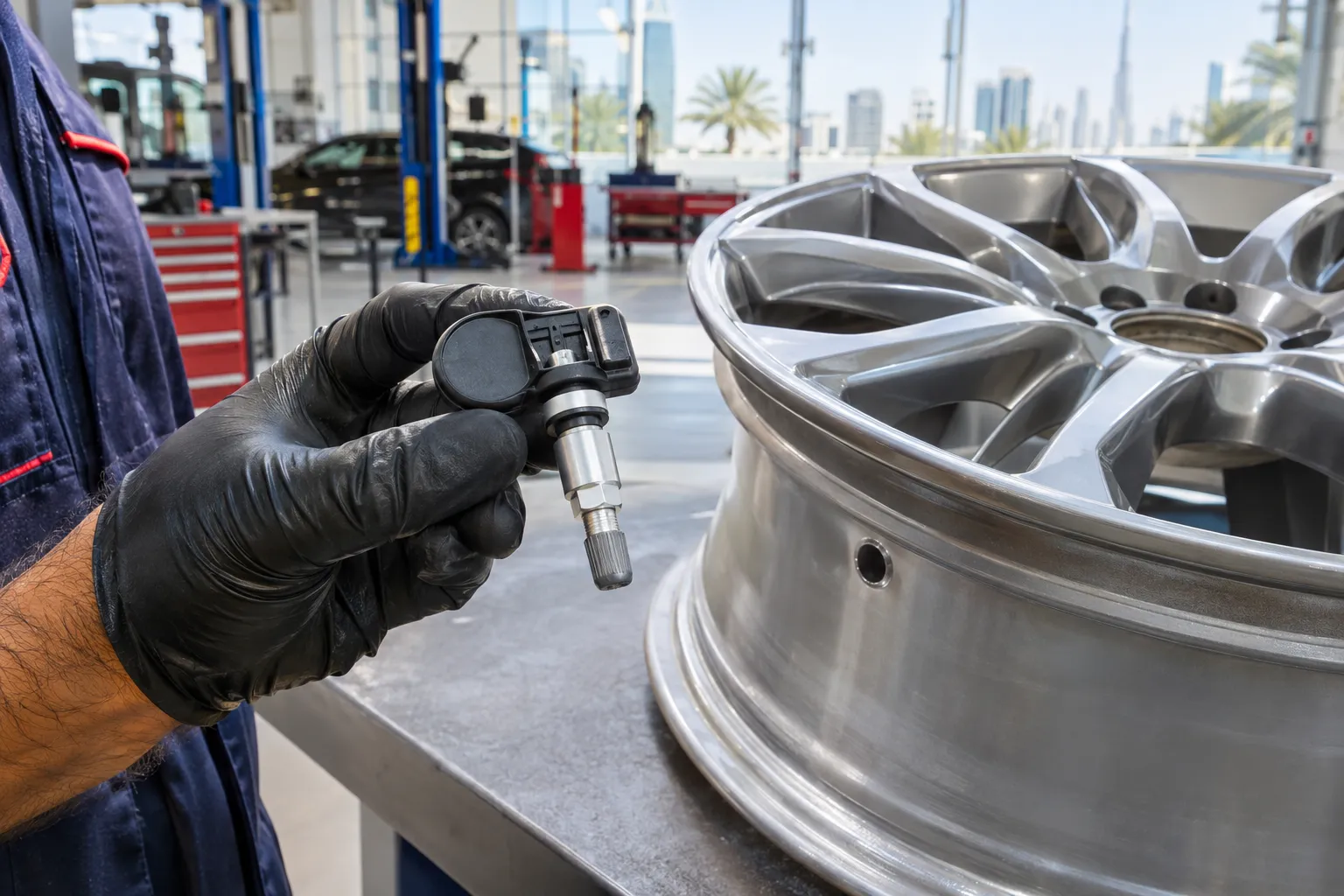
There’s one practical benefit I do notice in the workshop. Dry nitrogen means less moisture inside the wheel. On cars with aluminium-stem TPMS sensors, internal corrosion around the valve core is one of the reasons sensors and stems fail. Nitrogen won’t make a sensor last forever, but on cars kept for many years it helps a little. Valve cores and caps still need attention: a missing cap lets sand into the valve, and a leaking core will empty a nitrogen-filled tyre just as fast as an air-filled one. A valve replacement costs far less than a tyre ruined by running low.
Switching back to air
You can go back to ordinary air at any time. There’s no need to deflate the tyre or flush it first. Just top up to the correct cold pressure at any petrol station, and keep the green caps if you like; the next technician will simply see a tyre that once had nitrogen. On a road trip to Musandam or Salalah, where nitrogen stations are scarce, this is exactly what I’d do. A tyre at the right pressure with mixed gas is far safer than a tyre left low because you were waiting to find nitrogen.
Pressure still matters more than the gas
Last July I stopped for a customer on the Al Ain road with a shredded rear tyre and bright green valve caps. The tyres had nitrogen, fitted at a dealer a year before, and the driver believed they “never needed checking.” When I measured the surviving rear tyre it was at 21 psi against a recommended 33. That’s the problem with treating nitrogen as a cure.
Whatever gas you use, follow these UAE habits:
- Check pressure cold, in the morning or after the car has been parked for 3 hours.
- Never let air out of a hot tyre to bring it “back to normal” in the afternoon. The rise is expected.
- Use the door-jamb figure, not the maximum pressure printed on the sidewall.
- Check the spare too. Spares lose pressure in the boot heat just like road tyres.
Our tyre pressure guide covers the correct pressures for common UAE cars, and the summer tyre pressure article explains the hot-versus-cold numbers in detail.
Getting nitrogen or a pressure check
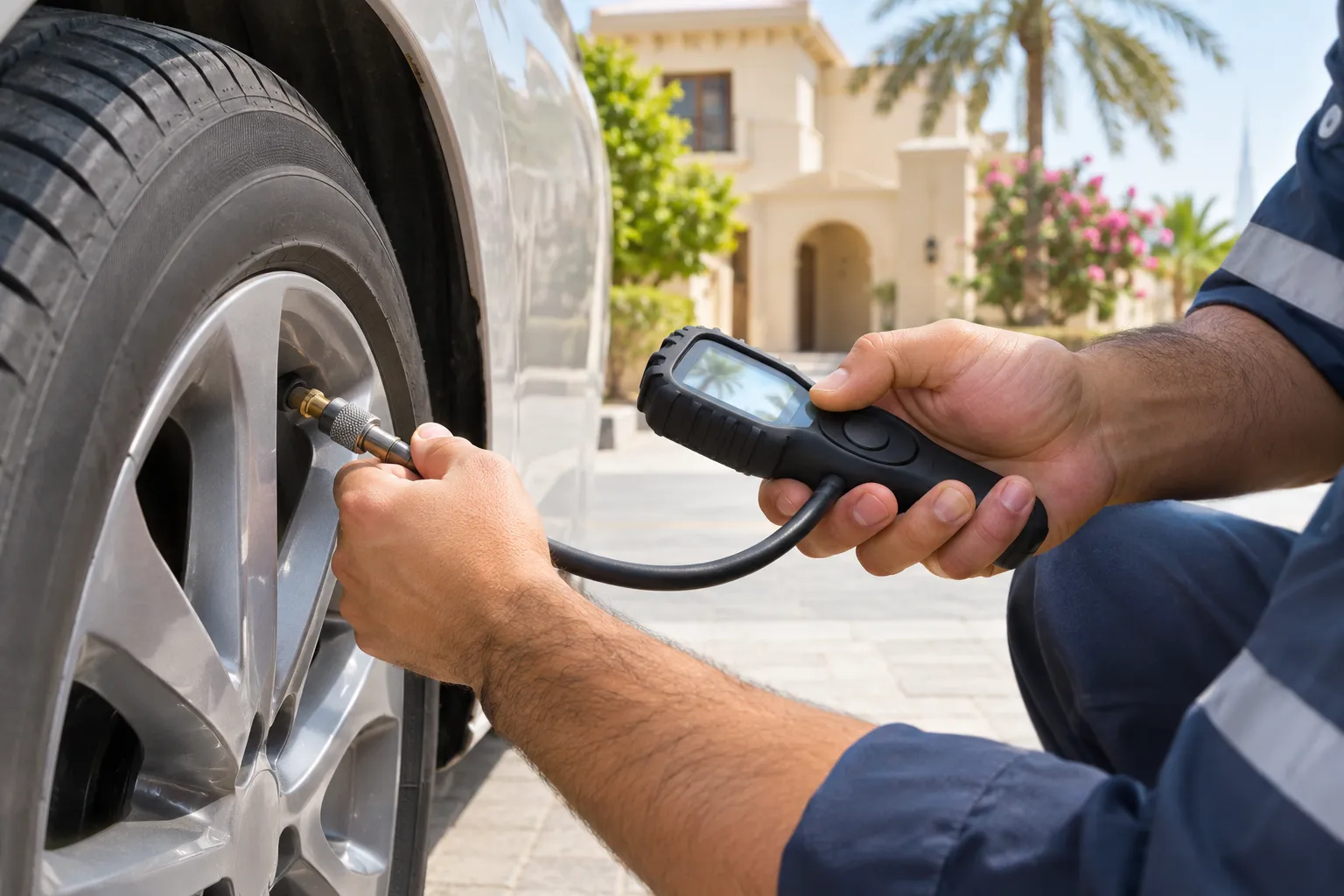
If you want nitrogen, it’s a cheap, low-risk upgrade. If you’d rather keep using air, that’s fine too. Just check it. Drop by our Al Quoz workshop for a free tyre pressure check, or ask for a nitrogen fill when our van comes to you for any other job.
Frequently asked questions
Can I mix nitrogen and normal air in my tyres?
Yes. It is completely safe. Air is already about 78% nitrogen, so topping up a nitrogen-filled tyre with air only lowers the purity a little. Correct pressure is always more important than the gas.
Does nitrogen stop tyres from bursting in summer?
No gas can prevent a burst caused by under-inflation, overloading, old rubber or damage. Nitrogen loses pressure slightly more slowly, which helps you stay at the right pressure, but you still need to check it.
What pressure should I put in nitrogen-filled tyres?
The same pressure as with air, as shown on the placard on your driver's door jamb or in the owner's manual. Nitrogen does not change the recommended pressure.
How much does nitrogen filling cost in Dubai?
We charge AED 10 per tyre for a nitrogen fill, and it is free when you buy new tyres from us. A pressure check and air top-up at our workshop is free.
About the author
Fazir Kamal — Fazir Kamal is a tyre technician with five years of hands-on work on UAE roads — roadside punctures on Sheikh Zayed Road at 2 a.m., run-flat fitments in DIFC basements, alignment on desert-driven Patrols. He writes and reviews the technical guides on TyrePuncture.ae.